Zero-Trust Security Architecture for Web Applications: Implementation Guide 2026
In the rapidly evolving digital landscape of 2026, where sophisticated cyber threats are the norm, the traditional perimeter-based security model is no longer sufficient. As a seasoned full-stack developer who's been in the trenches building and securing complex web applications for over a decade, I've witnessed firsthand the shift from "trust but verify" to "never trust, always verify." This paradigm shift is embodied by zero trust security web apps 2026, a critical approach for protecting your digital assets.
The stakes are higher than ever. Recent reports project that cybercrime damages will reach an astonishing $11.5 trillion annually by 2026, with web applications being a primary target. Breaches don't just cost money; they erode customer trust, damage brand reputation, and can lead to significant legal repercussions. If you're building or maintaining web applications today, understanding and implementing a robust zero trust architecture isn't just a good idea – it's a non-negotiable requirement. This guide will walk you through the practical steps and considerations for adopting zero trust in your web application development lifecycle, drawing from real-world expertise and current industry best practices.
This article delves deep into the actionable strategies for integrating zero trust principles into your development pipeline, from initial design to continuous monitoring. We'll explore how identity-based access, micro-segmentation, and continuous verification form the bedrock of a resilient security posture, ensuring your web applications are future-proof against the threats of tomorrow.
Understanding the Zero-Trust Imperative for Web Applications
At its core, zero trust security operates on the principle that no user, device, or application, whether inside or outside the network perimeter, should be implicitly trusted. Every access request must be authenticated, authorized, and continuously validated. For web applications, this means moving beyond simple login screens to a more granular, dynamic security model.
Why Traditional Security Fails in 2026
The traditional "castle-and-moat" security model assumes that everything inside the network is trustworthy once authenticated at the perimeter. However, modern web applications are distributed, often leveraging cloud services, APIs, and microservices, rendering a clear perimeter obsolete.
- Expanded Attack Surface: APIs, third-party integrations, and remote workforces mean the "perimeter" is everywhere.
- Insider Threats: A significant percentage of breaches originate from within, whether malicious or accidental.
- Sophisticated Lateral Movement: Once an attacker breaches the perimeter, traditional models offer little resistance to movement within the network.
- Ephemeral Environments: Cloud-native and containerized applications have dynamic lifecycles that traditional static firewalls struggle to secure effectively.
The Core Principles of Zero Trust for Web Apps
Zero trust isn't a single technology; it's a strategic approach built on several key tenets.
1. Verify Explicitly: All users, devices, and applications must be authenticated and authorized before granting access. This includes multi-factor authentication (MFA) and adaptive access policies.
2. Least Privilege Access: Users and applications should only be granted the minimum access necessary to perform their functions, for the shortest possible duration.
3. Assume Breach: Always operate under the assumption that a breach has occurred or is imminent. This drives continuous monitoring and rapid response.
4. Micro-segmentation: Divide your network and applications into smaller, isolated segments to limit lateral movement in case of a compromise.
5. Continuous Monitoring & Validation: Security posture is constantly assessed, and access policies are dynamically adjusted based on real-time context.
Implementing Identity-Based Access Control
The cornerstone of any zero-trust implementation for web applications is a robust identity and access management (IAM) system. In 2026, this goes far beyond simple username/password authentication.
Centralized Identity Provider (IdP) Integration
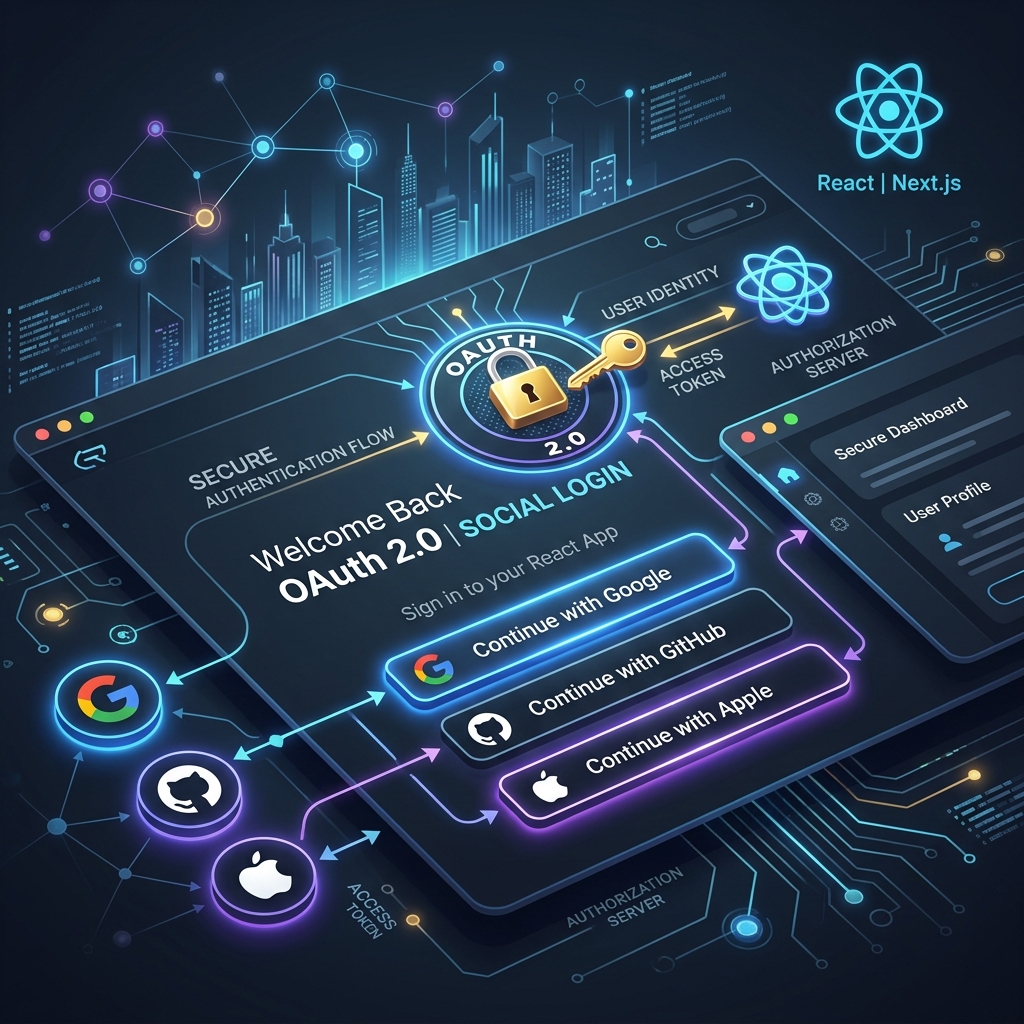
All authentication requests should flow through a centralized IdP. This standardizes authentication, simplifies user management, and enables advanced security features. For enterprise applications, solutions like Okta, Auth0, AWS Cognito, or Azure AD are excellent choices.
Let's consider a typical Next.js application using next-auth to integrate with an IdP.
// pages/api/auth/[...nextauth].js
import NextAuth from 'next-auth';
import OktaProvider from 'next-auth/providers/okta';

export default NextAuth({
  providers: [
    OktaProvider({
      clientId: process.env.OKTA_CLIENT_ID,
      clientSecret: process.env.OKTA_CLIENT_SECRET,
      issuer: process.env.OKTA_ISSUER,
    }),
  ],
  callbacks: {
    async jwt({ token, user, account, profile }) {
      // Persist the OAuth access_token and or the user id to the JWT session
      if (account) {
        token.accessToken = account.access_token;
        token.idToken = account.id_token;
      }
      if (user) {
        token.id = user.id;
      }
      return token;
    },
    async session({ session, token }) {
      // Send properties to the client, such as an access_token from a provider.
      session.accessToken = token.accessToken;
      session.idToken = token.idToken;
      session.user.id = token.id;
      return session;
    },
  },
  // ... other configurations
});
This snippet demonstrates how a Next.js app can be configured to use Okta as an IdP, ensuring all authentication requests are handled by a trusted, external service. This is a crucial step for achieving identity-based access.
Attribute-Based Access Control (ABAC)
Moving beyond role-based access control (RBAC), ABAC allows for more granular, dynamic authorization decisions based on a combination of user attributes (e.g., department, location, security clearance), resource attributes (e.g., data sensitivity, application module), and environmental attributes (e.g., time of day, device posture).
For a Laravel backend, implementing ABAC might involve a custom authorization service or integrating with an external policy engine.
// app/Policies/DocumentPolicy.php
namespace App\Policies;

use App\Models\User;
use App\Models\Document;
use Illuminate\Auth\Access\HandlesAuthorization;

class DocumentPolicy
{
    use HandlesAuthorization;

    public function view(User $user, Document $document): bool
    {
        // Example ABAC logic:
        // User must be in the 'finance' department AND document must be 'public'
        // OR user must have 'admin' role regardless of document type
        return ($user->department === 'finance' && $document->status === 'public')
               || $user->hasRole('admin')
               || ($user->location === $document->owner_location && $document->sensitivity <= $user->clearance_level);
    }
}

// In a controller
public function show(Document $document)
{
    $this->authorize('view', $document);
    // ...
}
This example shows a simplified Laravel policy where access to a document is determined by multiple attributes, not just a static role. This level of granularity is essential for robust web application security.
Micro-segmentation and Network Isolation
Micro-segmentation is a core tenet of zero trust, dramatically reducing the blast radius of a breach. Instead of a flat network, your web application components are isolated into small, distinct security segments.
Application-Level Segmentation
This involves isolating different components of your web application (e.g., frontend, backend API, database, message queues) from each other. Communication between these segments should be explicitly defined and secured.
- API Gateways: Use an API Gateway (e.g., AWS API Gateway, Nginx, Kong) to manage and secure all incoming API requests, acting as a single enforcement point.
- Service Meshes: For microservices architectures, a service mesh (e.g., Istio, Linkerd) provides powerful traffic management, security, and observability features, enabling fine-grained access control between services.
Consider a simple Nginx configuration for segmenting access to an API endpoint:
# /etc/nginx/sites-available/api.conf
server {
    listen 443 ssl;
    server_name api.yourwebapp.com;

    ssl_certificate /etc/letsencrypt/live/api.yourwebapp.com/fullchain.pem;
    ssl_certificate_key /etc/letsencrypt/live/api.yourwebapp.com/privkey.pem;

    location /v1/admin/ {
        # Only allow access from specific internal IPs or authenticated requests
        allow 192.168.1.0/24; # Example: internal management network
        deny all;
        # Or, for authenticated access:
        # auth_request /_verify_token;
        # proxy_set_header Authorization $http_authorization;
        proxy_pass http://internal_admin_service;
    }

    location /v1/public/ {
        # Publicly accessible, but still behind the API Gateway
        proxy_pass http://internal_public_service;
    }

    # ... other locations
}
This Nginx snippet demonstrates how different API paths can be segmented, with the /v1/admin/ endpoint restricted to an internal network segment, while /v1/public/ is more broadly accessible.
Network Policy Enforcement
Leverage cloud provider network policies (e.g., AWS Security Groups, Azure Network Security Groups, GCP Firewall Rules) or Kubernetes Network Policies to define explicit allowed traffic flows between your application components.
Comparison of Network Policy Approaches:
| Feature | AWS Security Groups | Kubernetes Network Policies |
| Scope | EC2 instances, RDS, Load Balancers | Pods within a Kubernetes cluster |
| Policy Definition | Ingress/Egress rules based on IP/CIDR, other SGs | YAML manifests, label-based selectors |
| Dynamic Nature | Can be updated via API, but often static once set | Highly dynamic, applied to changing Pod sets |
| Granularity | Instance/ENI level | Pod level, namespace level |
| Use Case | Protecting cloud VMs, databases, external services | Securing microservices, inter-pod communication |
By combining these approaches, you build a layered defense that severely restricts an attacker's ability to move laterally even if a single component is compromised. These are critical security best practices 2026.
Continuous Monitoring and Threat Detection
Zero trust is an ongoing process, not a one-time setup. Continuous monitoring and real-time threat detection are paramount to dynamically assess risk and enforce policies.
Security Information and Event Management (SIEM)
A centralized SIEM solution (e.g., Splunk, Elastic SIEM, Microsoft Sentinel) aggregates logs from all your web application components, infrastructure, and security tools. This provides a holistic view of your security posture, enabling correlation of events and detection of suspicious activities.
- Log Everything: Ensure your web servers (Nginx, Apache), application logs (Laravel, Node.js), database logs (MySQL, PostgreSQL), and cloud resource logs are sent to the SIEM.
- Anomaly Detection: Configure rules within your SIEM to detect unusual login patterns, unauthorized access attempts, data exfiltration, or sudden spikes in error rates.
- Incident Response Integration: Integrate your SIEM with your incident response playbooks and tools for automated alerting and remediation.
Runtime Application Self-Protection (RASP)
RASP solutions integrate directly into your web application's runtime environment, actively monitoring and blocking attacks in real-time. Unlike Web Application Firewalls (WAFs) that sit in front of the application, RASP has visibility into the application's internal logic and data flow.
- Protection against OWASP Top 10: RASP can protect against SQL Injection, XSS, broken authentication, and other common vulnerabilities by analyzing application behavior.
- Reduced False Positives: Because RASP understands the application context, it can often make more accurate decisions than network-level WAFs, leading to fewer false positives.
For a PHP application built with Laravel, a RASP agent would monitor framework functions and database queries for malicious patterns.
// (Conceptual) RASP agent detection in Laravel
// This code is illustrative, RASP agents are typically bytecode injected or framework-integrated
// and operate at a lower level.

class RASPDetector
{
    public function detectSQLInjection($query)
    {
        if (preg_match('/(UNION|SELECT|INSERT|DELETE|UPDATE)\s+(FROM|INTO|WHERE)/i', $query)) {
            Log::warning("Possible SQL Injection detected: " . $query);
            // Block request or alert
            return true;
        }
        return false;
    }

    public function detectXSS($input)
    {
        if (preg_match('/<script>|<\/script>|javascript:/i', $input)) {
            Log::warning("Possible XSS detected: " . $input);
            // Sanitize or block
            return true;
        }
        return false;
    }
}

// In a service provider or middleware, you might call this
// $detector = new RASPDetector();
// if ($detector->detectSQLInjection($request->input('search_query'))) {
//     abort(403, 'Malicious input detected.');
// }
While this is a simplified representation, it highlights how a RASP-like approach would inspect application inputs and outputs for threats. My experience developing secure solutions, including custom security modules, often involves building similar detection logic. You can explore more about my security development work on my /projects page.
Best Practices and Future Considerations for 2026
Adopting zero trust is a journey, not a destination. It requires continuous effort, adaptation, and a security-first mindset in your development team.
Secure by Design Principles
Integrate security into every stage of your Software Development Life Cycle (SDLC).
- Threat Modeling: Conduct regular threat modeling exercises for new features and applications to identify potential vulnerabilities early.
- Secure Coding Standards: Enforce secure coding practices (e.g., input validation, output encoding, parameterized queries) using tools like static application security testing (SAST) and dynamic application security testing (DAST).
- Automated Security Testing: Embed security tests into your CI/CD pipeline. This includes vulnerability scanning, dependency analysis, and API security testing.
Device Posture and Endpoint Security
For applications accessed by employees or partners, device posture assessment is crucial.
- Endpoint Detection and Response (EDR): Deploy EDR solutions on all managed devices to monitor for threats and ensure compliance.
- Conditional Access: Grant access based not only on user identity but also on the security state of the device (e.g., up-to-date OS, presence of antivirus, no jailbreak/root).
Supply Chain Security
As web applications increasingly rely on open-source libraries and third-party APIs, securing your software supply chain is paramount.
- Software Bill of Materials (SBOM): Generate and maintain SBOMs to track all components and their versions used in your applications.
- Vulnerability Scanning: Regularly scan your dependencies for known vulnerabilities using tools like Snyk or OWASP Dependency-Check.
- Trusted Registries: Use private, trusted package registries to cache and vet third-party components before they enter your build pipeline.
My professional experience, documented on my blank" rel="noopener noreferrer" style="color: var(--primary); text-decoration: none; border-bottom: 1px dashed var(--primary);">/experience page, includes architecting and implementing secure software supply chains for various clients. For deeper insights into secure coding practices, check out my other articles on the /blog.
Key Takeaways
Implementing zero trust security web apps 2026 is an essential strategic move for any organization. Here are the core principles to remember:
- Never Trust, Always Verify: Assume every request is malicious until proven otherwise.
- Identity is the New Perimeter: Centralized, strong identity authentication and granular authorization (ABAC) are fundamental.
- Segment Everything: Micro-segmentation limits the blast radius of any potential breach.
- Monitor Continuously: Real-time visibility and threat detection are crucial for dynamic policy enforcement.
- Integrate Security into SDLC: Build security in from the start, don't bolt it on as an afterthought.
FAQ – Zero Trust Security for Web Applications
Q1: What is the primary difference between zero trust and traditional security models for web apps?
A1: The primary difference lies in trust. Traditional models assume trust within the network perimeter, while zero trust assumes no implicit trust for any user, device, or application, regardless of its location. Every access request is explicitly verified, authorized, and continuously validated.
Q2: Is zero trust a product I can buy, or a strategy?
A2: Zero trust is fundamentally a security strategy and a philosophy, not a single product. It involves implementing a combination of technologies, processes, and policies (like strong IAM, micro-segmentation, and continuous monitoring) to achieve its goals. Many vendors offer solutions that help implement aspects of a zero-trust architecture.
Q3: How does micro-segmentation benefit web application security?
A3: Micro-segmentation divides your web application's network into smaller, isolated zones. This drastically limits lateral movement for attackers. If one component is compromised, the attacker's access is restricted only to that segment, preventing them from easily reaching other critical parts of your application or data.
Q4: What role does Multi-Factor Authentication (MFA) play in a zero-trust architecture?
A4: MFA is a critical component of "verify explicitly" in zero trust. By requiring multiple forms of verification (e.g., password + something you have like a phone or biometric), MFA significantly strengthens identity assurance, making it much harder for attackers to compromise user accounts and gain unauthorized access