Astro vs Next.js vs Remix: Best Meta-Framework for Content Sites in 2026
The web development landscape evolves at a blistering pace. What was cutting-edge last year might be standard, or even legacy, by 2026. For developers and businesses alike, choosing the right meta-framework for content-heavy websites – blogs, news portals, documentation sites, or e-commerce storefronts – is a critical decision that impacts performance, developer experience, scalability, and ultimately, ROI. As a senior full-stack developer with over a decade of experience navigating these shifts, I've seen frameworks rise and fall, and I've spent countless hours in the trenches building and optimizing.
In this deep dive, we're pitting three titans against each other: Astro, Next.js, and Remix. All three offer compelling solutions, but their philosophies, strengths, and ideal use cases diverge significantly. Our focus today is squarely on content sites in 2026, considering the ever-increasing demands for speed, SEO, maintainability, and dynamic capabilities. We'll explore their architectural approaches, performance characteristics, developer experience, and how they stack up against the future of web development.
By the end of this comprehensive comparison, you'll have a clear understanding of which framework is best suited for your next content-driven project, armed with practical insights and future-proof considerations. Let's dissect the contenders and determine the best React meta-framework for the coming years.
Understanding the Contenders: Architectural Philosophies
Before we dive into the nitty-gritty, it's crucial to grasp the core architectural philosophy behind each framework. This underpins their performance, developer experience, and suitability for different types of content sites.
Astro: The Island Architecture Champion
Astro has rapidly gained traction by championing the "Island Architecture." Unlike traditional SPAs or even most server-rendered applications that hydrate the entire page with JavaScript, Astro ships zero JavaScript by default. It allows you to use any UI framework (React, Vue, Svelte, Lit, etc.) components in isolation, rendering them to static HTML on the server. Only the interactive parts ("islands") are then hydrated with JavaScript, leading to incredibly fast page loads and superior Core Web Vitals.
For content sites, this is a game-changer. Imagine a blog post: the main content is static HTML, blazing fast. Only the comment section, a "like" button, or an interactive table of contents needs JavaScript. Astro excels at delivering this lean, performant experience. My work on complex documentation portals and marketing sites has often leveraged Astro for its unparalleled speed. You can see some of these performance-optimized projects at /projects.
Next.js: The Full-Stack React Powerhouse
Next.js, developed by Vercel, has long been the de facto standard for React applications, providing a robust, full-stack solution. It offers a spectrum of rendering strategies: Static Site Generation (SSG), Server-Side Rendering (SSR), and Incremental Static Regeneration (ISR). With the introduction of the App Router and React Server Components (RSCs) in Next.js 13 and beyond, its capabilities have expanded significantly, pushing the boundaries of what's possible with server-first React.
Next.js is incredibly versatile. For content sites, SSG is excellent for static blogs, while SSR or ISR can handle dynamic content like personalized news feeds or e-commerce product pages. Its comprehensive feature set, including API routes, image optimization, and internationalization, makes it a powerful choice for complex, interactive content platforms. I've built numerous enterprise-level applications with Next.js, from internal tools to high-traffic consumer-facing sites, showcasing its adaptability.
Remix: The Web Standards Enthusiast
Remix, from the creators of React Router, takes a different approach. It embraces web standards like HTTP caching, forms, and the browser's native capabilities, aiming to deliver a fast and resilient user experience without relying heavily on client-side JavaScript for basic interactions. It's a full-stack framework with a strong emphasis on server-side rendering and progressive enhancement.
Remix's philosophy resonates particularly well with developers who appreciate the robustness of the platform. For content sites, this means fast initial loads, excellent SEO by default, and a smooth user experience even with JavaScript disabled. Remix's nested routing and error handling are also standout features that simplify complex UIs. My experience with Remix has shown it to be particularly effective for applications where reliability and standard web interactions are paramount.
Performance & SEO: The Core Metric for Content Sites
In 2026, Google's EEAT guidelines and Core Web Vitals will be more critical than ever. Content sites live and die by their search engine ranking and user experience.
Astro's Unmatched Speed for Static Content
Astro's island architecture inherently leads to superior performance metrics for content sites. By shipping minimal to no JavaScript to the browser, it achieves extremely low Largest Contentful Paint (LCP) and First Input Delay (FID) scores. This translates directly to better SEO and a snappier user experience.
Key Performance Advantages:
- Zero JavaScript by default: Only interactive components hydrate.
- Faster Time To Interactive (TTI): Pages are usable almost instantly.
- Excellent Core Web Vitals: Naturally scores high on LCP, FID, and CLS.
- Static HTML output: Easy to cache globally via CDNs.
Consider a simple Astro component in React:
// src/components/Counter.jsx
import { useState } from 'react';

function Counter() {
  const [count, setCount] = useState(0);
  return (
    <button onClick={() => setCount(count + 1)}>
      Count: {count}
    </button>
  );
}

export default Counter;
In an Astro page, you'd import and use it like this:
---
// src/pages/index.astro
import Counter from '../components/Counter.jsx';
---
<!DOCTYPE html>
<html lang="en">
<head>
    <meta charset="UTF-8">
    <title>Astro Content Site</title>
</head>
<body>
    <h1>Welcome to my Astro Blog!</h1>
    <p>This paragraph is static HTML.</p>
    <Counter client:load /> {/* Only this component hydrates */}
</body>
</html>
The client:load directive tells Astro to hydrate the component only when it enters the viewport or after the page loads, keeping the initial payload tiny.
Next.js's Versatility with React Server Components
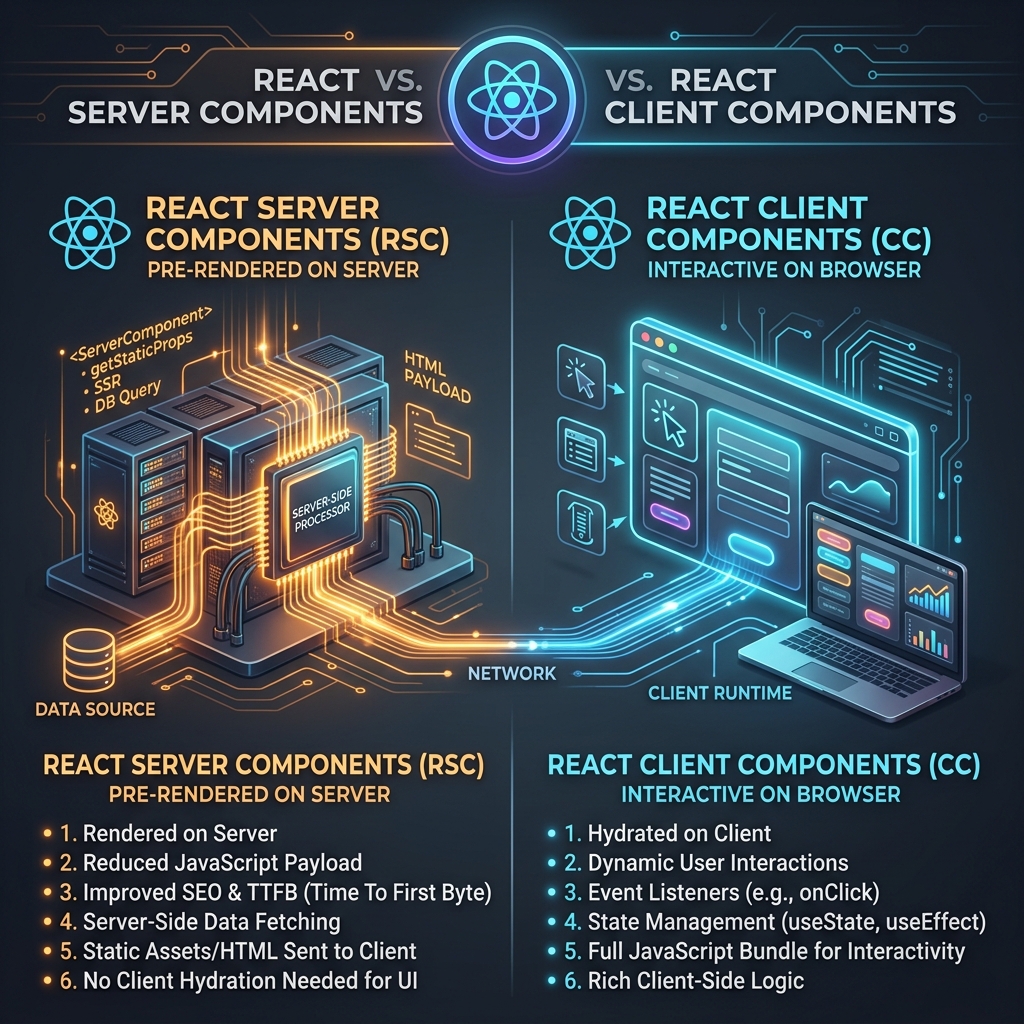
Next.js, especially with the App Router and React Server Components (RSCs), offers a powerful paradigm for managing server-side logic and reducing client-side JavaScript. RSCs allow you to fetch data and render components entirely on the server, sending only the resulting HTML and minimal client-side instructions.
Key Performance Advantages:
- Server-Side Rendering (SSR) & Static Site Generation (SSG): Choose the right strategy per page.
- React Server Components (RSCs): Reduces client-side bundle size and improves initial load.
- Image Optimization: Built-in
- Data Fetching: Flexible options with
fetchandasync/awaitin server components.
Here's a glimpse of a Server Component in Next.js 14+:
// app/blog/[slug]/page.jsx
import { getPostBySlug } from '@/lib/posts'; // Server-side data fetching

export default async function BlogPostPage({ params }) {
  const post = await getPostBySlug(params.slug); // Data fetching on the server

  return (
    <article>
      <h1>{post.title}</h1>
      <div dangerouslySetInnerHTML={{ __html: post.content }} />
      {/* Client Component for comments */}
      {/* <Comments postId={post.id} /> */}
    </article>
  );
}
This approach allows for highly dynamic content sites that still benefit from server-first rendering, ensuring good SEO and initial load performance.
Remix's Focus on Web Standards and Progressive Enhancement
Remix delivers excellent performance by leveraging browser features and minimizing client-side JavaScript for navigation and data mutations. Its use of standard HTML forms and HTTP methods means that even without JavaScript, a Remix application remains functional.
Key Performance Advantages:
- Server-Side Rendering (SSR) by default: Fast initial page loads.
- Nested Routing: Enables parallel data loading and partial re-renders, improving perceived performance.
- Optimistic UI: Built-in support for immediate UI updates, even before server confirmation.
- Robust Caching: Leverages HTTP caching headers effectively.
A typical Remix loader function for data fetching:
// app/routes/blog.$slug.tsx
import type { LoaderFunctionArgs } from "@remix-run/node";
import { json } from "@remix-run/node";
import { getPost } from "~/models/post.server"; // Server-side module

export const loader = async ({ params }: LoaderFunctionArgs) => {
  const slug = params.slug;
  if (!slug) {
    throw new Response("Not Found", { status: 404 });
  }
  const post = await getPost(slug); // Fetch data on the server
  if (!post) {
    throw new Response("Not Found", { status: 404 });
  }
  return json({ post });
};

export default function BlogPost() {
  const { post } = useLoaderData<typeof loader>();
  return (
    <article>
      <h1>{post.title}</h1>
      <p>{post.content}</p>
    </article>
  );
}
Remix's commitment to web standards inherently provides a strong foundation for SEO and accessibility.
Developer Experience & Ecosystem
The developer experience (DX) and the maturity of the ecosystem are crucial for long-term project success and team productivity.
Astro's Flexibility and Simplicity
Astro shines in its simplicity and framework-agnostic approach. Developers can use their preferred UI framework, or even mix and match them on a single page. This lowers the barrier to entry for teams with diverse skill sets and allows for incremental adoption. The learning curve for basic Astro is remarkably gentle.
DX Highlights:
- Multi-framework support: Use React, Vue, Svelte, etc., within the same project.
- Markdown & MDX first-class support: Ideal for content sites.
- Vite-powered dev server: Fast hot module reloading.
- Growing ecosystem of integrations: Adapters for various platforms, UI libraries.
However, its younger ecosystem means fewer pre-built components and patterns compared to Next.js. For complex, highly interactive applications, the "island" approach might require more thought in component architecture.
Next.js's Mature Ecosystem and Comprehensive Tooling
Next.js boasts the largest and most mature ecosystem among the three, especially within the React community. Its comprehensive tooling, extensive documentation, and vast community support make it an incredibly productive environment for developers.
DX Highlights:
- Vast React ecosystem: Access to millions of React components and libraries.
- Integrated features: Image optimization, font optimization, API routes, internationalization.
- Excellent documentation and community support: Easy to find answers and resources.
- Opinionated but flexible: Provides clear conventions while allowing customization.
The shift to the App Router and RSCs, while powerful, has introduced a steeper learning curve for existing Next.js developers and requires a deeper understanding of server-client component boundaries. This can be a hurdle, but the long-term benefits for performance and maintainability are significant.
Remix's Opinionated Simplicity and Web Standards Focus
Remix offers a refreshing developer experience by simplifying many common web development challenges through its adherence to web standards. Its nested routing, automatic revalidation, and error handling patterns are incredibly powerful and intuitive once understood.
DX Highlights:
- Strong conventions: Clear patterns for data loading, mutations, and error handling.
- Nested routing: Simplifies complex UI layouts and data dependencies.
- Automatic data revalidation: Reduces manual cache invalidation.
- TypeScript-first: Excellent type safety out of the box.
While Remix's ecosystem is smaller than Next.js's, it's growing rapidly. Its opinionated nature means less decision fatigue but also less flexibility in certain architectural choices. For developers comfortable with its paradigm, it offers a highly productive environment.
Use Cases for Content Sites in 2026
Let's break down which framework excels for specific types of content sites, considering the future trends.
When to Choose Astro
Astro is the undisputed champion for static-first content sites where performance and minimal JavaScript are paramount.
- Blogs, News Websites: Especially those with high traffic where every millisecond counts.
- Documentation Sites: Fast loading, SEO-friendly, and easy to maintain.
- Marketing & Landing Pages: Crucial for conversion rates and initial impressions.
- E-commerce Product Pages (static content): When product descriptions and images are largely static.
- Portfolios & Personal Websites: For developers and creatives showcasing their work. (Check out my portfolio at /projects).
If your content changes infrequently, or if the interactive elements are isolated, Astro will deliver an unparalleled user experience.
When to Choose Next.js
Next.js is the go-to for dynamic, interactive content platforms that require a full-stack solution and the extensive React ecosystem.
- Complex E-commerce Platforms: With dynamic pricing, user accounts, and personalized recommendations.
- Social Media Feeds & User-Generated Content: Requires frequent data fetching and real-time updates.
- Enterprise Content Management Systems (CMS): Integrating with complex backend services (e.g., headless CMS, custom APIs).
- Web Applications with Dashboards: Where content is intertwined with interactive components and user-specific data.
- Internal Tools & Admin Panels: Leveraging React's component model for rich interfaces.
Next.js's flexibility with rendering strategies makes it adaptable to a wide range of content dynamism.
When to Choose Remix
Remix excels for robust, resilient content applications that prioritize web standards, progressive enhancement, and a highly interactive but reliable user experience.
- Interactive Forms & User Input: E.g., surveys, comment sections with rich interaction, job application portals.
- Web Applications with Complex Data Mutations: Where data consistency and optimistic UI updates are critical.
- Content Platforms requiring strong accessibility: Its adherence to web standards aids this.
- Applications where server-side logic and client-side interactions are tightly coupled.
- Progressive Web Apps (PWAs): Leveraging its strong server-side and caching capabilities.
Remix provides a solid foundation for applications that need to be fast and functional, even under less-than-ideal network conditions.
Key Takeaways
Choosing between Astro, Next.js, and Remix for content sites in 2026 isn't about finding a single "best" framework, but rather the right framework for your specific needs.
1. Astro for Speed & Simplicity: If your primary goal is unparalleled performance, minimal JavaScript, and SEO dominance for static or mostly static content, Astro is your champion. It's ideal for blogs, documentation, and marketing sites.
2. Next.js for Full-Stack React & Scale: For dynamic, interactive content platforms requiring a rich React ecosystem, server-side capabilities, and flexible rendering strategies, Next.js remains a powerhouse. Its App Router and RSCs are shaping the future of React.
3. Remix for Web Standards & Resilience: If you value robust web standards, progressive enhancement, elegant handling of forms and data mutations, and a highly reliable user experience, Remix offers a compelling and productive approach.
My professional journey, documented at /experience, has involved building with all these technologies. The right choice often depends on the team's existing skill set, the project's specific performance requirements, and the long-term maintenance strategy.
FAQ: Astro vs Next.js vs Remix for Content Sites
Q1: Is Astro suitable for an e-commerce site with dynamic product listings?
A1: Astro excels for the static parts of an e-commerce site, like product display pages with mostly static content or marketing landing pages. For highly dynamic elements like shopping carts, user authentication, or real-time inventory updates, you would integrate interactive components (islands) built with React, Vue, etc. For a complete, dynamic e-commerce solution, Next.js or Remix might offer a more integrated experience for the highly interactive and authenticated parts, though Astro can be a powerful frontend for a headless e-commerce backend.
Q2: What's the biggest advantage of React Server Components (RSCs) in Next.js for content sites?
A2: The biggest advantage of RSCs for content sites is the ability to render components and fetch data entirely on the server without sending their JavaScript bundle to the client. This drastically reduces the client-side JavaScript payload, leading to faster initial page loads, improved Core Web Vitals, and better SEO. It allows for rich, dynamic content to be delivered efficiently, blurring the lines between traditional SSR and client-side rendering.
Q3: Can I use a headless CMS with all three frameworks?
A3: Absolutely! All three frameworks are excellent choices for consuming data from a headless CMS (e.g., Contentful, Strapi, Sanity, DatoCMS). They provide robust data fetching mechanisms (Astro's getStaticPaths and getStaticProps, Next.js's getStaticProps/getServerSideProps or RSCs, Remix's loader functions) to pull content during build time or on demand, making them highly compatible with a decoupled content architecture.
Q4: Which framework has the steepest learning curve for a developer new to meta-frameworks?
A4: For a developer entirely new to meta-frameworks, Astro generally has the gentlest learning curve, especially if they are already familiar with a UI framework like React or Vue. Its core concepts are straightforward. Next.js, particularly with its App Router and RSCs, can have a steeper learning curve