React Server Components vs. Client Components in React 19: When to Use Each Pattern in 2026
The landscape of web development is in constant flux, and few technologies have driven as much innovation and debate as React. With the advent of React 19 and its mature Server Components architecture, developers in 2026 are faced with a pivotal decision: when to render on the server, and when to render on the client. This isn't just a technical choice; it's a strategic one that impacts performance, developer experience, and the very economics of your application.
As a senior full-stack developer with over a decade of experience navigating these architectural shifts, I've seen firsthand the evolution from traditional server-side rendering (SSR) to the current sophisticated hybrid models. The promise of React Server Components (RSCs), first unveiled years ago, has now materialized into a robust, production-ready solution, deeply integrated into frameworks like Next.js. Understanding its nuances is no longer optional; it's essential for building high-performance, scalable web applications that meet the demands of modern users and search engines.
This comprehensive guide will cut through the noise, providing a practical, implementation-focused perspective on leveraging React Server Components and Client Components effectively in 2026. We'll delve into their core principles, explore real-world use cases, and equip you with the knowledge to make informed architectural decisions for your next project.
Understanding the Core Dichotomy: React Server Components (RSCs)
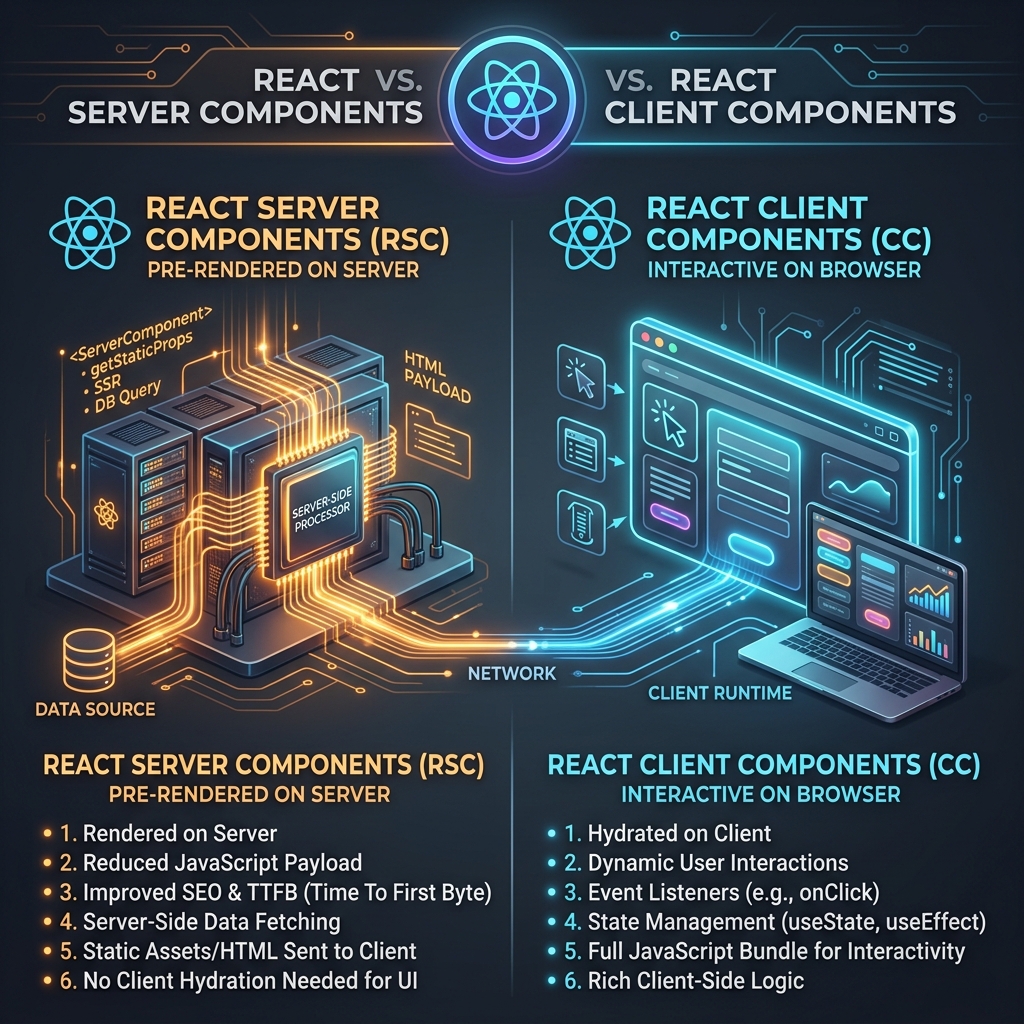
At its heart, the distinction between Server and Client Components revolves around where the rendering logic and data fetching occur. React Server Components execute exclusively on the server, producing a serialized representation of the UI that is then sent to the client. This paradigm shift offers significant advantages, particularly in terms of initial page load performance and data security.
What are React Server Components?
React Server Components are a new type of React component designed to run only on the server, allowing developers to collocate data fetching, database queries, and even API calls directly within their components. They render to an intermediate format – a stream of JSX – which is then sent to the client. The client-side React runtime seamlessly integrates this server-rendered output without needing to re-render or re-fetch data.
Key Characteristics of RSCs:
- Zero Bundle Size: RSCs are never sent to the client's browser. This means their dependencies (e.g., database drivers, large utility libraries) are not included in the client-side JavaScript bundle, drastically reducing download times.
- Direct Data Access: RSCs can directly interact with server-side resources like databases, file systems, or internal APIs, eliminating the need for separate API layers in many cases.
- Improved Performance: By fetching data and rendering UI on the server, the initial HTML payload can be delivered much faster, leading to quicker Time To First Byte (TTFB) and First Contentful Paint (FCP).
- Enhanced Security: Sensitive data and logic remain on the server, never exposed to the client.
The Role of Data Fetching in RSCs
One of the most compelling features of RSCs is their integrated approach to data fetching. Instead of using useEffect or client-side data fetching libraries, you can await promises directly within your Server Components. This simplifies the data flow and aligns more closely with traditional server-side rendering patterns.
Consider a typical scenario where you need to fetch user data for a profile page:
// app/profile/page.jsx - a Server Component
import { getUserProfile } from '@/lib/database'; // Server-side utility

async function ProfilePage({ params }) {
  const userId = params.id;
  const user = await getUserProfile(userId); // Direct database call or ORM query

  if (!user) {
    return <div>User not found.</div>;
  }

  return (
    <div className="container mx-auto p-4">
      <h1 className="text-3xl font-bold mb-4">{user.name}'s Profile</h1>
      <p>Email: {user.email}</p>
      <p>Bio: {user.bio}</p>
      {/* Imagine more complex UI here */}
      <RecentActivity userId={userId} /> {/* Another Server Component */}
    </div>
  );
}

export default ProfilePage;
In this example, getUserProfile could be a direct query to a MySQL database using a library like knex or an ORM like Prisma. This code never leaves the server. The client only receives the final HTML for the ProfilePage. This pattern is a game-changer for data-intensive applications, significantly streamlining the development process compared to traditional client-side data fetching.
The Enduring Need for Client Components
While Server Components bring revolutionary benefits, they don't replace Client Components entirely. Client Components remain crucial for any interactive UI, state management, and browser-specific functionalities. They are the familiar React components we've been using for years, marked by the 'use client' directive.
When to Use Client Components
Client Components are the workhorses for all client-side interactivity. If your component needs to:
- Manage state using
useStateoruseReducer. - Handle user interactions (e.g.,
onClick,onChange). - Use browser-specific APIs (e.g.,
localStorage,window,navigator). - Employ lifecycle effects with
useEffect. - Render components that rely on context providers (unless the provider itself is a Server Component).
- Integrate third-party libraries that rely heavily on client-side JavaScript (e.g., charting libraries, complex animation libraries).
Think of a "Like" button on a blog post. This button needs to maintain its "liked" state, send an API request when clicked, and update the UI accordingly. This is a classic Client Component use case.
// components/LikeButton.jsx - a Client Component
'use client'; // This directive is crucial!

import { useState } from 'react';

export default function LikeButton({ postId, initialLikes }) {
  const [likes, setLikes] = useState(initialLikes);
  const [isLiking, setIsLiking] = useState(false);

  const handleLike = async () => {
    if (isLiking) return;
    setIsLiking(true);
    try {
      // Simulate API call to update like count on the server
      const response = await fetch(`/api/posts/${postId}/like`, { method: 'POST' });
      if (response.ok) {
        setLikes(prevLikes => prevLikes + 1);
      } else {
        console.error('Failed to like post');
      }
    } catch (error) {
      console.error('Error liking post:', error);
    } finally {
      setIsLiking(false);
    }
  };

  return (
    <button
      onClick={handleLike}
      disabled={isLiking}
      className="bg-blue-500 hover:bg-blue-700 text-white font-bold py-2 px-4 rounded"
    >
      ❤️ {likes} Likes
    </button>
  );
}
This component clearly demonstrates the need for client-side state and interaction. Without the 'use client' directive, this component would attempt to render on the server, leading to errors because useState and fetch (in this context) are client-side APIs.
Interleaving Server and Client Components
The true power of React 19's architecture lies in the ability to seamlessly interleave Server and Client Components. A Server Component can render a Client Component, and a Client Component can render a Server Component (passed as a child or prop).
Server Component rendering Client Component:
// app/blog/[slug]/page.jsx - Server Component
import { getBlogPost } from '@/lib/blog-data';
import LikeButton from '@/components/LikeButton'; // Client Component

async function BlogPostPage({ params }) {
  const post = await getBlogPost(params.slug);

  if (!post) {
    return <div>Post not found.</div>;
  }

  return (
    <article className="prose lg:prose-xl mx-auto p-4">
      <h1>{post.title}</h1>
      <p>{post.content}</p>
      <div className="mt-8">
        <LikeButton postId={post.id} initialLikes={post.likes} />
      </div>
    </article>
  );
}

export default BlogPostPage;
Here, BlogPostPage (a Server Component) fetches the blog post data and then renders the interactive LikeButton (a Client Component), passing its initial data as props. The LikeButton's JavaScript is then downloaded and hydrated on the client.
Client Component rendering Server Component (as children):
This pattern is often used for layout components where the layout itself is interactive (e.g., a theme toggle), but its content should be server-rendered.
// components/InteractiveLayout.jsx - Client Component
'use client';

import { useState } from 'react';

export default function InteractiveLayout({ children }) {
  const [isSidebarOpen, setIsSidebarOpen] = useState(false);

  return (
    <div className="flex">
      <aside className={`w-64 bg-gray-800 text-white ${isSidebarOpen ? 'block' : 'hidden'}`}>
        {/* Sidebar content */}
      </aside>
      <main className="flex-1 p-4">
        <button onClick={() => setIsSidebarOpen(!isSidebarOpen)}>Toggle Sidebar</button>
        {children} {/* Server Component content rendered here */}
      </main>
    </div>
  );
}

// app/dashboard/page.jsx - Server Component
import InteractiveLayout from '@/components/InteractiveLayout';
import { getDashboardData } from '@/lib/dashboard-data';

async function DashboardPage() {
  const data = await getDashboardData(); // Server-side data fetching

  return (
    <InteractiveLayout>
      {/* This content is a Server Component, passed as children */}
      <div>
        <h1 className="text-2xl font-bold">Dashboard Overview</h1>
        <p>Welcome, user!</p>
        <p>Total Sales: ${data.totalSales}</p>
        {/* More dashboard UI */}
      </div>
    </InteractiveLayout>
  );
}

export default DashboardPage;
In this scenario, the InteractiveLayout is a Client Component because it manages the sidebar's open/close state. However, the actual content within the layout (children) can be a Server Component, benefiting from server-side data fetching and zero bundle size. This is a powerful pattern for building complex, interactive applications with optimal performance.
Architectural Patterns and Best Practices for 2026
Navigating the Server vs. Client component decision requires a strategic mindset. In 2026, with React 19 and frameworks like Next.js 15+ maturing, several best practices have emerged to maximize the benefits of this hybrid approach.
Prioritizing Server Components by Default
A good rule of thumb is to default to Server Components. Start by making every new component a Server Component. Only introduce the 'use client' directive when you explicitly need client-side interactivity or browser APIs. This "server-first" approach ensures you automatically reap the performance and security benefits wherever possible. According to a recent 2025 developer survey, teams adopting a server-first strategy reported an average 15% improvement in initial load times and a 10% reduction in client-side bundle sizes.
The "Client Boundary" Principle
When you mark a component with 'use client', it creates a "client boundary." All modules imported by that component (and its children, unless they are explicitly Server Components passed as props/children from a Server Component parent) will also be treated as client-side code. Be mindful of where you place this directive. Placing it too high in your component tree can inadvertently force large parts of your application to be client-rendered, negating the benefits of RSCs.
Example of an anti-pattern:
// app/layout.jsx - Server Component (implicitly)
// DON'T DO THIS unless absolutely necessary!
'use client'; // This makes the ENTIRE layout and all its children client-side

import { useState } from 'react';
import Navbar from './navbar'; // Will also be client-side
import Footer from './footer'; // Will also be client-side

export default function RootLayout({ children }) {
  const [theme, setTheme] = useState('light'); // A small piece of client state
  return (
    <html lang="en" className={theme}>
      <body>
        <Navbar />
        {children}
        <Footer />
      </body>
    </html>
  );
}
In this example, if only Navbar needed a small piece of client-side state, marking the entire RootLayout as a client component would unnecessarily hydrate Footer and potentially many children components that could otherwise be server-rendered. Instead, push the 'use client' directive down to the lowest possible component that requires client interactivity.
Strategic Data Fetching with Caching
In 2026, efficient data fetching is paramount. React 19's integration with frameworks like Next.js allows for sophisticated caching strategies for RSCs. Data fetched in Server Components can be automatically memoized and deduplicated, reducing redundant database calls. Furthermore, the ability to revalidate cached data on demand or based on a time-to-live (TTL) ensures your server-rendered content is always fresh without sacrificing performance.
For instance, in a Next.js application, you can leverage the fetch API's extended options for caching:
// lib/data.js
export async function getProducts() {
  const response = await fetch('https://api.example.com/products', {
    next: { revalidate: 3600 }, // Revalidate every hour
  });
  return response.json();
}

// app/products/page.jsx - Server Component
import { getProducts } from '@/lib/data';

async function ProductsPage() {
  const products = await getProducts();
  // ... render products
}
This simple revalidate option can dramatically improve performance by serving cached data while still ensuring freshness, reducing the load on your backend services.
Performance and SEO Implications
The choice between Server and Client Components has profound implications for both application performance and search engine optimization (SEO). In 2026, Google's Core Web Vitals continue to be a critical ranking factor, and RSCs are perfectly positioned to optimize for them.
Optimizing Core Web Vitals with RSCs
| Metric | Server Components Benefit |