Container Orchestration with Docker Compose: A Developer Team Guide for 2026
In the rapidly evolving landscape of software development, consistency, scalability, and ease of deployment are no longer luxuries-they are necessities. By 2026, the adoption of containerization is projected to reach over 90% in enterprise environments, with Docker remaining a foundational technology. While individual Docker containers are powerful, managing an ecosystem of interconnected services for a complex application can quickly become a bottleneck, especially for development teams. This is where Docker Compose orchestration steps in as an indispensable tool, transforming a jumble of services into a cohesive, manageable unit.
As a seasoned full-stack developer who has navigated the complexities of microservices architectures and monoliths alike, I've seen firsthand the transformative power of a well-orchestrated local development environment. From accelerating onboarding for new team members to ensuring parity between development, staging, and production, Docker Compose offers a robust solution. This guide isn't just about syntax; it's about embedding Docker Compose multi-service management into your team's DNA, optimizing your containerized development workflow for peak efficiency and future readiness.
We'll dive deep into practical strategies for leveraging Docker Compose to streamline your development process, enhance collaboration, and prepare your applications for the next generation of cloud-native deployments. Expect to walk away with actionable insights and configuration examples that you can immediately apply to your projects, whether you're building a cutting-edge Next.js frontend with a Laravel API or a sophisticated React application backed by a MySQL database.
The Indispensable Role of Docker Compose in Modern Development Workflows
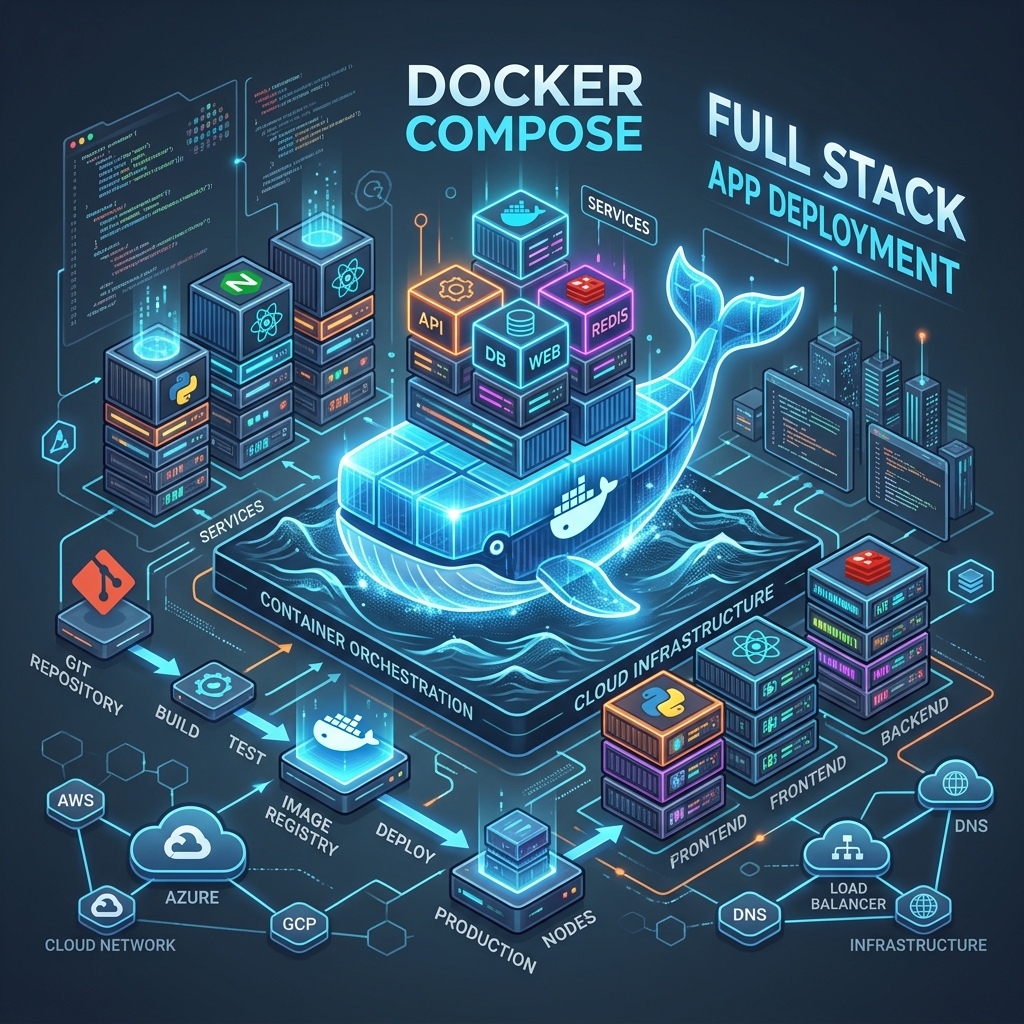
Docker Compose serves as a declarative configuration tool for defining and running multi-container Docker applications. Instead of managing individual containers via complex docker run commands, Compose allows you to define your entire application stack-services, networks, and volumes-in a single docker-compose.yml file. This simplicity is its greatest strength, particularly for local development Docker setups.
By 2025, an estimated 70% of new applications will be developed using container-native principles, according to Gartner. This shift mandates tools that can handle the complexity of distributed systems from the get-go. Docker Compose provides that abstraction layer, enabling developers to spin up complex environments with a single command, ensuring consistency across different machines and operating systems.
What is Docker Compose Orchestration?
Docker Compose orchestration refers to the process of defining, linking, and managing multiple Docker containers as a single application unit using a docker-compose.yml file. It automates the setup of inter-container communication, networking, and volume management, allowing developers to focus on application logic rather than infrastructure plumbing.
Key benefits include:
- Simplified Environment Setup: Onboard new developers in minutes, not hours or days.
- Consistency Across Environments: Minimize "it works on my machine" issues by ensuring dev, staging, and production environments are as similar as possible.
- Version Control for Infrastructure: Treat your infrastructure definition (the
docker-compose.ymlfile) as code, versioning it alongside your application. - Efficient Resource Management: Define resource limits and dependencies for services.
Architecting Multi-Service Applications with Docker Compose
When designing a Docker Compose multi-service application, consider the logical separation of concerns. Each service should ideally be a single, independent unit that performs a specific function. For instance, a typical web application might include:
- A web server (e.g., Nginx, Apache)
- An application server (e.g., Node.js, PHP-FPM, Python Gunicorn)
- A database (e.g., MySQL, PostgreSQL, MongoDB)
- A caching layer (e.g., Redis, Memcached)
- A message queue (e.g., RabbitMQ, Kafka)
Here's a simplified docker-compose.yml example for a Laravel API backend with a Next.js frontend and a MySQL database:
# docker-compose.yml
version: '3.8'

services:
  # Laravel API Backend
  app:
    build:
      context: ./backend
      dockerfile: Dockerfile
    image: myapp-backend:1.0
    container_name: myapp_backend
    restart: unless-stopped
    volumes:
      - ./backend:/var/www/html
      - app-storage:/var/www/html/storage
    environment:
      DB_CONNECTION: mysql
      DB_HOST: db
      DB_PORT: 3306
      DB_DATABASE: myapp_db
      DB_USERNAME: ${MYSQL_USER}
      DB_PASSWORD: ${MYSQL_PASSWORD}
      APP_ENV: local
      APP_DEBUG: ${APP_DEBUG:-true}
    networks:
      - app-network
    depends_on:
      - db
      - redis

  # Nginx Web Server
  nginx:
    image: nginx:latest
    container_name: myapp_nginx
    ports:
      - "80:80"
      - "443:443"
    volumes:
      - ./backend:/var/www/html
      - ./nginx/nginx.conf:/etc/nginx/conf.d/default.conf
    networks:
      - app-network
    depends_on:
      - app

  # MySQL Database
  db:
    image: mysql:8.0
    container_name: myapp_db
    restart: unless-stopped
    environment:
      MYSQL_DATABASE: myapp_db
      MYSQL_ROOT_PASSWORD: ${MYSQL_ROOT_PASSWORD}
      MYSQL_USER: ${MYSQL_USER}
      MYSQL_PASSWORD: ${MYSQL_PASSWORD}
    volumes:
      - db-data:/var/lib/mysql
    networks:
      - app-network

  # Redis Cache/Queue
  redis:
    image: redis:latest
    container_name: myapp_redis
    restart: unless-stopped
    ports:
      - "6379:6379"
    networks:
      - app-network

  # Next.js Frontend
  frontend:
    build:
      context: ./frontend
      dockerfile: Dockerfile
    image: myapp-frontend:1.0
    container_name: myapp_frontend
    restart: unless-stopped
    ports:
      - "3000:3000"
    volumes:
      - ./frontend:/app
      - /app/node_modules # Anonymous volume to prevent host node_modules from overwriting
    environment:
      NEXT_PUBLIC_API_URL: http://localhost/api # Or http://nginx for internal network
    networks:
      - app-network
    depends_on:
      - nginx # Frontend might need the API to be up, though usually API is called by browser

volumes:
  db-data:
  app-storage:

networks:
  app-network:
    driver: bridge
This example demonstrates how each service is defined with its own image, volumes, environment variables, and network configuration. The depends_on directive ensures services start in the correct order, though it doesn't wait for services to be "ready." For more robust readiness checks, consider health checks or application-level retry logic.
Mastering Docker Networking for Seamless Container Communication
One of the most powerful and often underestimated features of Docker Compose is its built-in networking capabilities. When you define services in a docker-compose.yml file, Compose automatically sets up a default network for your application. This allows containers to communicate with each other using their service names as hostnames, simplifying configuration significantly. This is critical for a smooth containerized development workflow.
Understanding Docker Compose Network Types
Docker Compose primarily uses bridge networks for its default configuration. A bridge network is a software bridge that allows containers connected to it to communicate. It also provides isolation from containers not connected to that network.
- Default Bridge Network: If you don't specify any networks in your
docker-compose.yml, Compose creates a default network named after your project directory. - User-Defined Bridge Networks: As shown in the example above, explicitly defining networks (e.g.,
app-network) gives you more control. This is best practice for larger applications or when you need specific network configurations. - Host Network: Allows containers to share the host's network stack. This can be useful for performance but sacrifices network isolation. Generally not recommended for multi-service applications in Compose due to port conflicts.
For our Laravel and Next.js example, the app-network allows the app (PHP-FPM) service to communicate with db (MySQL) and redis using their service names. Similarly, nginx can proxy requests to app using http://app:9000 (assuming PHP-FPM is listening on port 9000).
# nginx/nginx.conf (snippet for backend proxy)
server {
    listen 80;
    server_name localhost;
    root /var/www/html/public;

    index index.php index.html index.htm;

    location / {
        try_files $uri $uri/ /index.php?$query_string;
    }

    location ~ \.php$ {
        fastcgi_pass app:9000; # Communicate with 'app' service
        fastcgi_index index.php;
        fastcgi_buffers 16 16k;
        fastcgi_buffer_size 32k;
        fastcgi_param SCRIPT_FILENAME $document_root$fastcgi_script_name;
        include fastcgi_params;
    }
}
Notice how fastcgi_pass app:9000; directly references the app service name. This is the power of Docker Compose networking in action.
Advanced Networking with External Networks and Overlays
While bridge networks suffice for most local development Docker setups, you might encounter scenarios requiring more advanced networking:
- External Networks: If you have existing Docker networks that you want your Compose application to connect to, you can declare them as external. This is useful for integrating with other standalone containers or applications running outside your Compose stack.
- Overlay Networks: For multi-host deployments (e.g., Docker Swarm), overlay networks enable seamless communication between containers running on different Docker hosts. While Compose itself is primarily for single-host orchestration, understanding overlay networks is crucial for scaling your containerized applications beyond local development.
For detailed documentation on Docker networking, I highly recommend consulting the official Docker documentation on networking.
Optimizing Your Containerized Development Workflow
A well-configured Docker Compose setup can drastically improve developer productivity. It standardizes the development environment, reducing setup time and "works on my machine" issues.
Hot-Reloading and Live-Reloading for Rapid Development
One common challenge with containerized environments is ensuring a smooth development experience, especially with features like hot-reloading for frontends or automatic code updates for backends.
- Volume Mounting: The most crucial technique is volume mounting. By mounting your local source code directory into the container, any changes you make on your host machine are immediately reflected inside the container.
    # frontend service in docker-compose.yml
    volumes:
      - ./frontend:/app
      - /app/node_modules # Important: Prevent host node_modules from overwriting container's
In the Next.js example, mounting /app/nodemodules as an anonymous volume ensures that the nodemodules directory inside the container is used, preventing issues if your host's node_modules are incompatible or missing.
- Watchers and Development Servers: Ensure your application's development server (e.g.,
npm run devfor Next.js/React,php artisan servefor Laravel, or a watch command for compilation) is running within the container. These tools typically detect file changes and trigger recompilations or reloads.
For a Next.js application, your Dockerfile might look like this:
    # frontend/Dockerfile
    FROM node:20-alpine
    WORKDIR /app
    COPY package*.json ./
    RUN npm install
    # We don't COPY the rest of the code here, as it will be mounted via volume
    EXPOSE 3000
    CMD ["npm", "run", "dev"]
When you run docker compose up, npm run dev starts, and thanks to volume mounting, it picks up your local code changes.
Managing Environment Variables and Secrets
Handling environment variables and sensitive data (secrets) is paramount in any application. Docker Compose offers several mechanisms:
-
.envfiles: Docker Compose automatically loads environment variables from a.envfile located in the same directory as yourdocker-compose.yml. This is ideal for non-sensitive configuration that might vary between developers (e.g.,APPDEBUG,APPURL).
    # .env
    MYSQL_ROOT_PASSWORD=supersecretroot
    MYSQL_USER=devuser
    MYSQL_PASSWORD=devpassword
    APP_DEBUG=true
These variables are then referenced in docker-compose.yml using ${VARIABLE_NAME}.
-
environmentdirective: Define variables directly within the service definition. Useful for variables specific to that service.
- Docker Secrets: For truly sensitive production-grade secrets, Docker Secrets (part of Docker Swarm) or external secret management services (like HashiCorp Vault, AWS Secrets Manager, Azure Key Vault) are recommended. While Compose itself doesn't offer a native "secrets" feature for standalone mode, you can mount secret files as volumes or use external tools. For a deep dive into secure practices, check out our article on secure cloud deployments.
Database Migrations and Seeding
Automating database setup is a cornerstone of an efficient containerized development workflow.
- Initialize database schema: For development, you often want to start with a fresh database. You can use Docker entrypoint scripts or Compose commands to run migrations and seeders.
    # app service (modified)
    command: >
      bash -c "php artisan migrate --force &&
               php artisan db:seed --force &&
               php-fpm"
While convenient for dev, be cautious with --force in production. For a robust solution, you might run migrations as a separate one-off service or a docker exec command.
- One-off commands: For ad-hoc tasks like running a single migration, clearing cache, or executing a custom script, use
docker compose exec.
    docker compose exec app php artisan migrate
    docker compose exec app php artisan cache:clear
This approach ensures that your database state is consistent and easily reproducible for every team member.
Integrating with CI/CD and Cloud Deployments
While Docker Compose is primarily a single-host orchestrator, its principles and docker-compose.yml definitions form an excellent foundation for CI/CD pipelines and preparing for larger cloud deployments. By 2026, 85% of organizations are expected to run containerized applications in production, with Kubernetes being the dominant orchestrator (Cloud Native Computing Foundation).
From Compose to Kubernetes: A Stepping Stone
Docker Compose is not Kubernetes, but it's an excellent way to define your application's services, dependencies, and networking locally. This definition can then be translated into Kubernetes manifests. Tools like Kompose (an official CNCF project) can help convert docker-compose.yml files into Kubernetes objects (Deployments, Services, etc.).
# Example using Kompose
kompose convert -f docker-compose.yml
This command generates .yaml files for Kubernetes, allowing you to deploy your application to a cluster. While Kompose provides a starting point, manual refinement is often necessary to fully leverage Kubernetes' advanced features like Ingress, Horizontal Pod Autoscaling, and specific storage classes. My team often uses this as a baseline for our containerized development workflow before hand-crafting production-grade Kubernetes manifests. For complex deployments or enterprise solutions, feel free to contact us to discuss our expertise in cloud-native transformations.
CI/CD Pipeline Integration
Docker Compose can be integrated into your CI/CD pipeline for:
- Automated Testing: Spin up your entire application stack, run integration tests, and tear it down. This ensures your tests run in an environment identical to your development setup.
- Building Images: Your
Dockerfiles defined indocker-compose.ymlare used to build production-ready images. - Pre-deployment Checks: Validate your
docker-compose.ymlfor syntax and configuration errors.
Consider a GitHub Actions workflow snippet for a Laravel application:
# .github/workflows/ci.yml
name: CI Pipeline

on:
  push:
    branches:
      - main
  pull_request:
    branches:
      - main

jobs:
  build-and-test:
    runs-on: ubuntu-latest

    steps:
    - name: Checkout code
      uses: actions/checkout@v3

    - name: Copy .env.example to .env
      run: cp .env.example .env

    - name: Set up Docker Compose
      run: docker compose up -d --build

    - name: Wait for services to be healthy
      run: docker compose ps

    - name: Run migrations and seeders
      run: docker compose exec app php artisan migrate --force && docker compose exec app php artisan db:seed --force

    - name: Run Laravel tests
      run: docker compose exec app php artisan test

    - name: Bring down services
      if: always()
      run: docker compose down
This pipeline brings up the services defined in docker-compose.yml, runs migrations, executes tests, and then tears down the environment. This ensures that every code