Laravel Vue.js vs Next.js: A 2026 Full-Stack Showdown
As a senior full-stack developer with over a decade in the trenches, I've witnessed the web development landscape evolve from monolithic PHP applications to the current era of sophisticated JavaScript frameworks and hybrid architectures. In 2026, the choice between robust, battle-tested ecosystems and modern, performance-optimized stacks is more critical than ever. Two contenders consistently emerge in discussions for building scalable, maintainable web applications: the classic, yet ever-evolving, Laravel with Vue.js, often supercharged by Inertia.js, and the increasingly dominant Next.js.
This isn't just about picking a framework; it's about making a strategic decision that impacts development velocity, scalability, and long-term maintainability. Are you building a complex enterprise application with intricate business logic, or a blazing-fast, SEO-optimized content platform? The answer dictates your path. In this comprehensive comparison, we’ll dive deep into the nuances of the Laravel Vue.js vs Next.js debate, examining their architectural paradigms, performance characteristics, developer experience, and ideal use cases, providing insights grounded in real-world project experience.
By the end of this article, you'll have a clearer understanding of which stack aligns best with your project's goals, helping you navigate the complexities of modern full-stack development. We'll cut through the hype and focus on practical implications, ensuring your decision is informed by expertise and the demands of the 2026 digital landscape.
Architectural Paradigms: Monolith vs. JAMstack Evolution
The fundamental difference between Laravel Vue.js and Next.js often boils down to their architectural philosophies. Laravel, even with a modern frontend, traditionally leans towards a monolithic backend, while Next.js embodies the principles of the modern JAMstack (JavaScript, APIs, Markup) and its evolution into server-side rendered (SSR) and static-site generated (SSG) applications.
The Laravel Monolithic Approach (with Inertia.js)
Laravel, a PHP framework, has long been the backbone for millions of web applications, known for its elegant syntax and comprehensive feature set. When paired with Vue.js, it creates a powerful full-stack experience. The traditional approach involved Laravel serving HTML views, with Vue.js enhancing interactivity on the client-side. However, the game-changer for this combination in recent years has been Inertia.js.
Inertia.js allows you to build single-page applications (SPAs) using classic server-side routing and controllers. Instead of building a REST API, your Laravel controllers return Inertia responses, which are essentially JSON payloads containing data and a reference to the Vue component to render. This dramatically simplifies the full-stack development process by eliminating the need for client-side routing and API management.
Pros of Laravel with Inertia.js:
- Unified Development: You write your backend and frontend logic within the same codebase, often using PHP for controllers and Vue for views, leading to a more cohesive development experience.
- Rapid Prototyping: The simplicity of Inertia.js means you can build features incredibly fast, without the overhead of API design and client-side state management for routing.
- Mature Ecosystem: Laravel's ecosystem is vast, offering robust ORM (Eloquent), authentication, queues, and testing utilities out-of-the-box. Vue.js also boasts a rich component library and community.
- SEO-Friendly (with SSR): While Inertia.js primarily focuses on client-side rendering, it can be combined with server-side rendering solutions for improved SEO and initial load times, though this adds complexity.
Cons of Laravel with Inertia.js:
- Tightly Coupled: The frontend and backend are inherently linked, which can make scaling them independently more challenging compared to a decoupled architecture.
- Server-Side Dependency: Every page load (even within the SPA) still hits the Laravel backend, which might be a bottleneck for extremely high-traffic, static-content-heavy sites.
// Example: Laravel Controller with Inertia Response
use Inertia\Inertia;
use App\Models\Product;

class ProductController extends Controller
{
    public function index()
    {
        return Inertia::render('Products/Index', [
            'products' => Product::all()->map(fn ($product) => [
                'id' => $product->id,
                'name' => $product->name,
                'price' => $product->price,
            ]),
        ]);
    }
}
<!-- Example: Vue component rendered by Inertia -->
<template>
  <div>
    <h1>Our Products</h1>
    <ul>
      <li v-for="product in products" :key="product.id">
        {{ product.name }} - ${{ product.price }}
      </li>
    </ul>
  </div>
</template>

<script setup>
import { defineProps } from 'vue';

const props = defineProps({
  products: Array,
});
</script>
Next.js: The Modern JavaScript Full-Stack
Next.js, built on top of React, takes a different approach. It’s a powerful React framework that enables server-side rendering (SSR), static site generation (SSG), and client-side rendering (CSR) out of the box. It’s designed for building fast, SEO-friendly, and scalable web applications. The "full-stack" aspect in Next.js often refers to its ability to handle both frontend rendering and backend API routes within the same project, typically deployed as serverless functions.
Pros of Next.js:
- Performance & SEO: With SSR and SSG capabilities, Next.js applications deliver excellent performance metrics (Core Web Vitals) and are highly optimized for search engines. This is a significant advantage for content-heavy sites.
- Scalability & Decoupling: By leveraging serverless functions for API routes and static hosting for frontend assets, Next.js applications can scale horizontally with ease. The frontend and backend are logically separated, even if co-located in the same repository.
- Developer Experience: The file-system-based routing, built-in image optimization, and data fetching utilities streamline development. The React ecosystem is vast and constantly evolving.
- Global Reach: Ideal for global applications, as static assets can be served from CDNs, minimizing latency for users worldwide.
Cons of Next.js:
- JavaScript Everywhere: While a pro for JavaScript developers, it means the entire stack (frontend and backend logic via API routes) is in JavaScript, which might not appeal to teams with strong PHP expertise.
- Complex State Management: For large SPAs, managing global state in React can become complex, often requiring libraries like Redux or Zustand.
- Backend Limitations: Next.js API routes are excellent for simple data fetching and mutations, but for complex business logic, background jobs, or intricate database interactions, you might still need a dedicated backend service (e.g., a separate Node.js, Python, or even Laravel API).
// Example: Next.js Server-Side Rendered Page
// pages/products/[id].js

import React from 'react';

function ProductDetail({ product }) {
  if (!product) return <div>Loading...</div>;

  return (
    <div>
      <h1>{product.name}</h1>
      <p>Price: ${product.price}</p>
      <p>{product.description}</p>
    </div>
  );
}

export async function getServerSideProps(context) {
  const { id } = context.params;
  // In a real app, this would fetch from a database or external API
  const res = await fetch(`https://api.example.com/products/${id}`);
  const product = await res.json();

  return {
    props: {
      product,
    },
  };
}

export default ProductDetail;
Developer Experience and Ecosystem
The developer experience (DX) is paramount for project success, impacting everything from onboarding new team members to long-term maintenance. Both stacks offer excellent DX, but cater to different preferences and team compositions.
Laravel's Opinionated Elegance
Laravel's philosophy is "developer happiness." It provides an opinionated structure and a rich set of tools that guide developers towards best practices. Its Artisan CLI tool simplifies many common tasks, from database migrations to queue management. The PHP ecosystem, while mature, has also seen significant modernization, with powerful tools like Composer for dependency management and PHPUnit for testing.
The integration of Vue.js, especially with Inertia.js, feels incredibly natural. You write Vue components as you normally would, and Laravel handles the data plumbing. For teams deeply familiar with PHP and SQL databases, the learning curve is gentle. The comprehensive documentation and a vibrant community further enhance the DX. For those looking to build robust CRUD applications, CRM systems, or internal tools, the speed of development with Laravel and Vue.js is unparalleled.
Next.js's Modern JavaScript Powerhouse
Next.js thrives in the JavaScript ecosystem. Developers already proficient in React will find themselves immediately productive. The framework's conventions for routing, data fetching, and API routes are intuitive. The ability to write both frontend and (simple) backend logic in JavaScript appeals to many modern full-stack developers.
The tooling around Next.js is also top-notch, leveraging Webpack, Babel, and TypeScript (first-class support). The development server offers hot module replacement, ensuring a smooth and fast feedback loop. The React community provides an immense array of libraries and components, from UI kits to state management solutions. For projects requiring cutting-edge frontend features, interactive dashboards, or highly dynamic user interfaces, Next.js offers a compelling DX.
Performance, Scalability, and Deployment
Performance is no longer a luxury; it's a necessity for user retention and SEO rankings. Scalability ensures your application can grow with your user base, and deployment ease impacts operational costs.
Laravel Vue.js: Robust Backend, Flexible Frontend Scaling
A Laravel application typically runs on a server (e.g., Nginx or Apache) with PHP-FPM, backed by a database like MySQL or PostgreSQL. Scaling involves horizontal scaling of PHP servers and optimizing database performance. For the Vue.js frontend, once compiled, it's served as static assets from the Laravel public directory or a CDN.
Performance:
- Server-side processing: Laravel handles requests on the server, which can introduce latency depending on server load and database queries.
- Inertia.js efficiency: Inertia reduces full page reloads, making subsequent navigation feel fast, similar to a SPA.
- Database optimization: Efficient database queries, caching (Redis/Memcached), and optimized server configurations are crucial for performance.
Scalability:
- Horizontal scaling: Adding more PHP-FPM instances and load balancing them is a common strategy.
- Database scaling: Read replicas, sharding, and managed database services (e.g., AWS RDS) are options for scaling the database.
- Queue workers: Laravel's robust queue system (e.g., with Redis or SQS) allows offloading long-running tasks, significantly improving response times.
Deployment:
- Traditional hosting: Can be deployed on shared hosting, VPS, or dedicated servers.
- PaaS: Platforms like Laravel Forge, Ploi, or even Heroku offer streamlined Laravel deployment.
- Containerization: Dockerizing Laravel applications is increasingly common for consistent environments and easier scaling on Kubernetes.
Next.js: Edge-Native Performance and Serverless Scalability
Next.js shines in the performance and scalability department, largely due to its rendering strategies and serverless-first approach.
Performance:
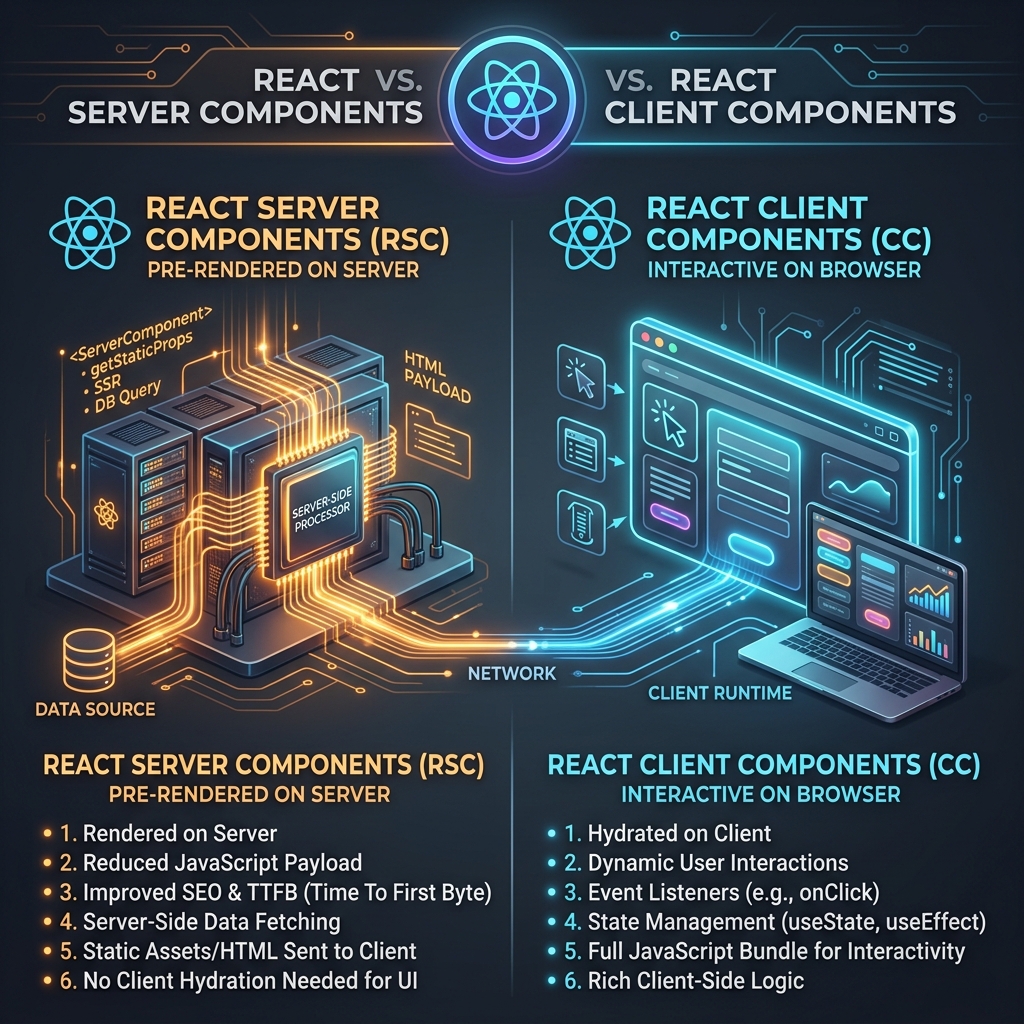
- SSR/SSG: Delivers pre-rendered HTML to the browser, leading to faster Time To First Byte (TTFB) and improved Core Web Vitals. Static assets are served globally via CDNs.
- Image Optimization: Built-in image optimization (
next/image) automatically optimizes and serves images in modern formats, reducing payload size. - API Routes as Serverless Functions: API routes are deployed as serverless functions (e.g., AWS Lambda, Vercel Edge Functions), which scale automatically based on demand and incur costs only when used.
Scalability:
- Automatic Scaling: Serverless functions scale elastically, making Next.js ideal for unpredictable traffic spikes.
- CDN Advantage: Static and SSR content benefits from global CDN distribution, providing low-latency access to users worldwide.
- Decoupled Services: If you integrate with external backend APIs, those can be scaled independently, offering maximum flexibility.
Deployment:
- Vercel (Official): Next.js is developed by Vercel, offering an incredibly optimized and seamless deployment experience with automatic scaling, CDN, and serverless functions.
- Netlify, AWS Amplify: Other platforms also provide excellent support for deploying Next.js applications, especially those leveraging SSG.
- Self-hosting: Can be self-hosted on Node.js servers, but this loses some of the serverless advantages.
Use Cases and Ideal Scenarios
Choosing between these two powerful stacks often comes down to the specific requirements and nature of your project.
When to Choose Laravel Vue.js (with Inertia.js)
- Complex Business Logic & Data-Intensive Applications: Ideal for CRMs, ERPs, internal tools, SaaS platforms with intricate workflows, and applications with heavy database interactions. Laravel's ORM and database tooling are incredibly powerful.
- Existing PHP Expertise: If your team has strong PHP and Laravel experience, this stack leverages that expertise efficiently, leading to faster development cycles.
- Rapid Prototyping & MVPs: The cohesive nature of Inertia.js allows for incredibly fast iteration from concept to deployable product.
- Traditional Monolithic Preference: For applications where a single codebase for both frontend and backend is desired for simplicity and easier management.
- Backend-Heavy Applications: Where the primary complexity lies in managing data, business rules, and integrations, with a rich but not excessively dynamic frontend.
Example: Building a custom project management system for a medium-sized enterprise, or a content management system with extensive administrative features. Many of our internal applications at Our Company Name] are built on this robust stack, showcasing its reliability for mission-critical systems. Check out some of our [projects to see it in action.
When to Choose Next.js
- High-Performance Public Websites: E-commerce stores, marketing sites, blogs, news portals, or any application where initial load time and SEO are paramount.
- Content-Heavy Applications: Ideal for static content generation and serving, providing unparalleled speed and reliability.
- Scalable Web Applications: Projects expecting massive traffic and requiring elastic scaling without significant operational overhead.
- Modern Interactive User Interfaces: Applications demanding highly dynamic, real-time, or interactive frontends that benefit from React's component-based architecture.
- JavaScript-First Teams: If your development team is primarily JavaScript-focused and prefers a unified language across the stack.
Example: Building a global e-commerce platform, a dynamic data visualization dashboard, or a personal portfolio site that needs to load instantly. For front-end heavy applications or those requiring advanced UI/UX, our skills in Next.js development have proven invaluable.
Key Takeaways
| Feature | Laravel Vue.js (Inertia.js) | Next.js |
| Architecture | Monolithic (PHP backend, SPA frontend via Inertia.js) | Modern JavaScript Full-Stack (SSR, SSG, CSR, API Routes) |
| Primary Language | PHP (Backend), JavaScript/Vue.js (Frontend) | JavaScript/TypeScript (Full Stack) |
| Performance Focus | Backend efficiency, database queries, SPA navigation | Initial page load, SEO, static asset delivery, serverless APIs |
| Scalability | Horizontal scaling of PHP servers, database, queues | Serverless functions, CDN for static/SSR, automatic scaling |
| Developer Experience | Opinionated, unified codebase, strong PHP/Laravel ecosystem | React-centric, modern tooling, JavaScript-everywhere |
| Ideal Use Cases | Complex business logic, admin panels, SaaS, CRMs, existing PHP teams | High-performance public sites, e-commerce, blogs, global apps |
| Deployment | Traditional servers, PaaS, Docker | Vercel, Netlify, AWS Amplify (serverless), self-hosting |
FAQ Section
Q1: Can I use Vue.js with Next.js?
A1: While Next.js is primarily built around React, it is technically possible to integrate Vue.js components into a Next.js project using custom Webpack configurations or by treating Vue components as external libraries. However, this is generally not recommended as it complicates the build process and loses many of the optimizations Next.js provides for React. For a Vue.js-centric SSR experience, Nuxt.js would be the more appropriate framework.
Q2: Is Laravel still relevant in 2026 compared to JavaScript frameworks?
A2: Absolutely. Laravel's relevance remains strong in 2026 due to its mature ecosystem, robust feature set, and continuous innovation. For applications requiring complex backend logic, database management, and a stable, well-documented framework, Laravel remains a top choice. Its ability to integrate seamlessly with modern frontends like Vue.js (especially with Inertia.js) ensures it stays competitive against JavaScript-only stacks. Our experience with diverse client projects consistently shows Laravel's enduring power.
Q3: Which stack is better for SEO?
A3: Next.js generally has an edge in SEO due to its built-in server-side rendering (SSR) and static site generation (SSG) capabilities. These features ensure that search engine crawlers receive fully rendered HTML, improving indexing and ranking. While Laravel with Vue.js can implement SSR, it often requires additional setup and complexity. For content-heavy public websites where SEO is a primary concern, Next.js is often the more straightforward choice.