Best CRM Features for Study Abroad Agencies: A Developer's Perspective
The global education market is projected to reach an astounding $10 trillion by 2030, with international student mobility playing a significant role. Study abroad agencies are at the forefront of this growth, connecting aspiring students with educational opportunities worldwide. However, managing thousands of student inquiries, applications, visa processes, and university communications across multiple countries is a logistical nightmare without robust technological support. Many agencies still grapple with fragmented data, manual processes, and missed opportunities, directly impacting their conversion rates and student satisfaction. This isn't just an operational challenge; it's a technical one, demanding sophisticated software solutions.
As a full-stack developer with extensive experience building EdTech platforms, I've seen firsthand how a well-architected Student Relationship Management (SRM) system, often a specialized CRM, can be a game-changer. It's not just about tracking leads; it's about orchestrating a complex, multi-stage journey for each student. From initial outreach to post-arrival support, the right CRM features for study abroad agencies can transform chaos into a streamlined, data-driven operation. This article will delve into the essential education CRM features from a technical perspective, highlighting what makes a system truly effective for international student recruitment.
We'll explore the critical functionalities, underlying architectural considerations, and best practices for implementing an SRM that scales, integrates seamlessly, and empowers agencies like ApplyBoard, Edvoy, and AECC Global to thrive in a competitive landscape. This isn't just a feature list; it's a blueprint for developers aiming to build the next generation of student management features and agency software.
The Foundation: Robust Student Data Management & Profiling
At the core of any effective SRM for study abroad agencies is a comprehensive and flexible student data management system. This goes far beyond basic contact information; it requires a detailed, evolving profile that tracks every facet of a student's journey.
Centralized Student Profiles with Custom Fields
A student's profile is a living document. It needs to capture academic history, language proficiency, financial capacity, program preferences, test scores (IELTS, TOEFL, GRE, GMAT), and even personal interests. From a developer's standpoint, this demands a flexible schema.
-- Example: MySQL table for student profiles
CREATE TABLE students (
    id INT AUTO_INCREMENT PRIMARY KEY,
    first_name VARCHAR(255) NOT NULL,
    last_name VARCHAR(255) NOT NULL,
    email VARCHAR(255) UNIQUE NOT NULL,
    phone_number VARCHAR(50),
    country_of_residence VARCHAR(100),
    preferred_destination VARCHAR(255),
    academic_level ENUM('High School', 'Undergraduate', 'Postgraduate', 'PhD'),
    ielts_score DECIMAL(3,1),
    toefl_score INT,
    gpa DECIMAL(3,2),
    financial_proof_status ENUM('Pending', 'Submitted', 'Verified', 'Insufficient'),
    counselor_id INT,
    created_at TIMESTAMP DEFAULT CURRENT_TIMESTAMP,
    updated_at TIMESTAMP DEFAULT CURRENT_TIMESTAMP ON UPDATE CURRENT_TIMESTAMP,
    FOREIGN KEY (counselor_id) REFERENCES users(id)
);

-- Example: JSONB for flexible custom fields in PostgreSQL
ALTER TABLE students ADD COLUMN custom_fields JSONB DEFAULT '{}';
Using JSONB fields in PostgreSQL or a separate key-value table for custom attributes provides the necessary flexibility without constant schema migrations. This allows agencies to add specific fields relevant to new university partners or evolving visa requirements without developer intervention.
Document Management and Secure Storage
International applications are document-heavy: transcripts, passports, visa documents, letters of recommendation, SOPs, and more. A secure, version-controlled document management system is non-negotiable. Integration with cloud storage solutions like AWS S3 or Google Cloud Storage is crucial for scalability and security.
// Example: Laravel controller snippet for file upload to S3
use Illuminate\Support\Facades\Storage;

public function uploadDocument(Request $request, Student $student)
{
    $request->validate([
        'document' => 'required|file|mimes:pdf,doc,docx,jpg,png|max:10240', // 10MB limit
        'document_type' => 'required|string'
    ]);

    $path = $request->file('document')->store("students/{$student->id}/documents", 's3');

    // Store metadata in database
    $student->documents()->create([
        'name' => $request->file('document')->getClientOriginalName(),
        'path' => $path,
        'type' => $request->document_type,
        'uploaded_by' => Auth::id()
    ]);

    return response()->json(['message' => 'Document uploaded successfully', 'path' => $path]);
}
Implementing access controls (RBAC) ensures only authorized personnel can view sensitive documents. Versioning is also key, allowing agencies to track changes and revert if needed, crucial for audit trails.
Streamlined Application & Admissions Workflow Management
The application process is the most complex part of a study abroad journey. An effective SRM must provide robust tools to manage this workflow end-to-end, from initial application submission to offer acceptance.
Intuitive Application Tracking & Status Updates
Students and counselors need real-time visibility into application statuses. This requires a granular status tracking system that reflects each stage: "Application Started," "Documents Pending," "Submitted to University," "Interview Scheduled," "Conditional Offer," "Unconditional Offer," "Visa Applied," "Visa Approved," etc.
A finite state machine (FSM) pattern can be effectively used here. Libraries like symfony/workflow in PHP or custom implementations in JavaScript can manage state transitions and associated actions.
// Example: Simplified state transition in Laravel
enum ApplicationStatus: string
{
    case Started = 'started';
    case DocumentsPending = 'documents_pending';
    case SubmittedToUniversity = 'submitted_to_university';
    case OfferReceived = 'offer_received';
    case OfferAccepted = 'offer_accepted';
    case VisaApplied = 'visa_applied';
    case VisaApproved = 'visa_approved';
    case Rejected = 'rejected';
}

class Application extends Model
{
    protected $casts = [
        'status' => ApplicationStatus::class,
    ];

    public function updateStatus(ApplicationStatus $newStatus): bool
    {
        // Add business logic for valid transitions
        if ($this->canTransitionTo($newStatus)) {
            $this->status = $newStatus;
            $this->save();
            // Trigger event for notifications, counselor updates etc.
            event(new ApplicationStatusUpdated($this));
            return true;
        }
        return false;
    }

    private function canTransitionTo(ApplicationStatus $newStatus): bool
    {
        // Define allowed transitions based on current status
        switch ($this->status) {
            case ApplicationStatus::Started:
                return in_array($newStatus, [ApplicationStatus::DocumentsPending, ApplicationStatus::Rejected]);
            case ApplicationStatus::DocumentsPending:
                return in_array($newStatus, [ApplicationStatus::SubmittedToUniversity, ApplicationStatus::Rejected]);
            // ... more transitions
            default:
                return false;
        }
    }
}
This ensures data integrity and prevents invalid state changes. Front-end components, perhaps built with React or Next.js, would dynamically update based on these statuses, providing a seamless UX.
University & Course Database Integration
Agencies often partner with hundreds of universities offering thousands of courses. A robust database of these institutions and programs, complete with requirements, deadlines, and tuition fees, is crucial. This can be built internally or integrated via APIs from university aggregators or direct university portals.
// Example: Simplified university data structure
{
    "university_id": "U001",
    "name": "University of Toronto",
    "country": "Canada",
    "city": "Toronto",
    "website": "https://www.utoronto.ca",
    "programs": [
        {
            "program_id": "P001",
            "name": "Master of Computer Science",
            "level": "Postgraduate",
            "duration_months": 24,
            "entry_requirements": {
                "gpa_min": 3.0,
                "ielts_min": 6.5,
                "toefl_min": 90,
                "degree_required": "BSc in Computer Science or related"
            },
            "application_deadlines": {
                "fall_2025": "2025-01-15",
                "spring_2026": "2025-09-01"
            },
            "tuition_fees_cad": 40000
        }
    ]
}
The ability to filter and search this database efficiently is a key requirement for counselors to match students with suitable programs, a core feature for platforms like Edvoy.
Communication & Engagement Tools
Effective communication is the lifeblood of a study abroad agency. Students, counselors, and university representatives need to interact seamlessly.
Integrated Email, SMS, and Chat Functionality
An SRM should consolidate all communication channels. This means integrating with email services (SendGrid, Mailgun), SMS gateways (Twilio), and potentially live chat platforms. All interactions should be logged against the student's profile.
// Example: Sending an email notification with Laravel
use App\Mail\ApplicationStatusUpdate;
use Illuminate\Support\Facades\Mail;

// In your ApplicationService
public function notifyStudentOfStatusChange(Application $application)
{
    Mail::to($application->student->email)->send(new ApplicationStatusUpdate($application));
}
For real-time chat, WebSocket technologies (e.g., Laravel Echo with Pusher/Ably, or Socket.IO with Node.js) are essential. This allows counselors to engage students directly within the platform, improving response times and student satisfaction.
Automated Notifications and Reminders
Proactive communication significantly reduces manual workload. The system should automatically send reminders for upcoming deadlines, missing documents, or follow-ups. This is a prime candidate for event-driven architecture.
// Example: Next.js/React component to display notifications
import { useEffect, useState } from 'react';
import { fetchNotifications } from '../api/notifications'; // API call

export default function NotificationCenter() {
  const [notifications, setNotifications] = useState([]);

  useEffect(() => {
    const loadNotifications = async () => {
      const data = await fetchNotifications();
      setNotifications(data);
    };
    loadNotifications();

    // Setup WebSocket listener for real-time notifications
    // Echo.private(`users.${userId}`)
    //   .notification((notification) => {
    //     setNotifications((prev) => [notification, ...prev]);
    //   });
  }, []);

  return (
    <div className="notification-center">
      <h2>Your Notifications</h2>
      {notifications.length === 0 ? (
        <p>No new notifications.</p>
      ) : (
        <ul>
          {notifications.map((notification) => (
            <li key={notification.id} className={notification.read ? 'read' : 'unread'}>
              {notification.message} - <small>{new Date(notification.created_at).toLocaleString()}</small>
            </li>
          ))}
        </ul>
      )}
    </div>
  );
}
This reduces the burden on counselors and ensures students are always informed, a critical factor for successful applications given the tight deadlines (e.g., for Fall 2025 intakes, applications often close in early 2025).
Advanced Analytics & Reporting
Data is power, especially in the competitive EdTech landscape. Agencies need deep insights into their operations to optimize performance and identify trends.
Customizable Dashboards and Performance Metrics
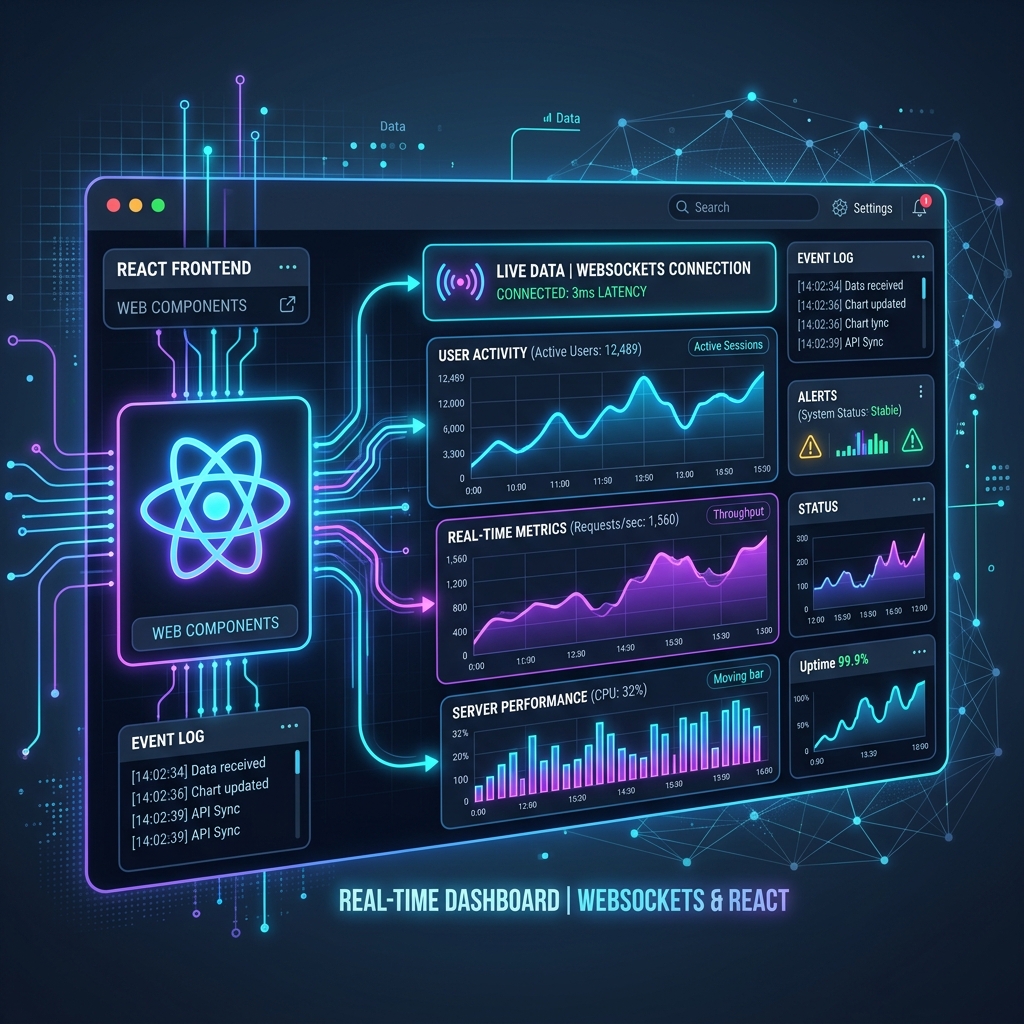
Counselors, managers, and executives require different views of the data. Customizable dashboards allow each role to focus on relevant KPIs: lead conversion rates, application success rates, counselor performance, revenue projections, and regional trends.
| Metric | Description | Example Calculation |
| Lead Conversion Rate | % of leads that become enrolled students | (Enrolled Students / Total Leads) * 100 |
| Application Success Rate | % of applications leading to an offer | (Offers Received / Applications Submitted) * 100 |
| Counselor Load | Number of active students per counselor | Total Active Students / Number of Counselors |
| Average Processing Time | Time from lead capture to offer acceptance | SUM(Time Taken) / Total Applications |
Building these dashboards with charting libraries (Chart.js, Recharts, D3.js) and a robust backend API (Laravel/Node.js) that can aggregate and filter data efficiently is key. For large datasets, consider data warehousing solutions or analytical databases.
Predictive Analytics and AI for Student Matching
Leveraging AI and machine learning can significantly enhance the student-university matching process. By analyzing historical data on student profiles, academic performance, preferences, and successful placements, the system can recommend optimal programs and universities.
# Example: Simplified Python snippet for a recommendation engine (pseudo-code)
import pandas as pd
from sklearn.neighbors import NearestNeighbors
from sklearn.preprocessing import StandardScaler

def recommend_universities(student_profile, historical_data):
    # Preprocess historical data and student profile
    df = pd.DataFrame(historical_data)
    student_df = pd.DataFrame([student_profile])

    # Select relevant features for matching (GPA, IELTS, program type, etc.)
    features = ['gpa', 'ielts_score', 'financial_capacity_usd', 'ranking_preference']

    # Scale numerical features
    scaler = StandardScaler()
    scaled_data = scaler.fit_transform(df[features])
    scaled_student = scaler.transform(student_df[features])

    # Use Nearest Neighbors for similarity search
    model = NearestNeighbors(n_neighbors=5, algorithm='ball_tree')
    model.fit(scaled_data)

    distances, indices = model.kneighbors(scaled_student)

    # Return top N similar universities/programs
    recommended_programs = df.iloc[indices[0]]['university_program_id'].tolist()
    return recommended_programs

# This would typically run as a microservice or a scheduled job.
This moves beyond simple filtering to intelligent suggestions, improving efficiency and student satisfaction. This is a feature seen in leading platforms like ApplyBoard, which uses sophisticated algorithms for matching.
Seamless Integrations & Extensibility
No SRM exists in a vacuum. It must be part of a larger ecosystem, integrating with various external services and allowing for future expansion.
Third-Party API Integrations (Universities, Payment Gateways, CRM)
Direct API integrations with university application portals can automate submissions, reducing manual data entry errors. Payment gateway integrations (Stripe, PayPal) are essential for processing application fees or deposits. Furthermore, some agencies might already use a general-purpose CRM (Salesforce, HubSpot) and need to sync data.
// Example: Laravel service for integrating with a hypothetical University API
namespace App\Services;

use Illuminate\Support\Facades\Http;

class UniversityApi
{
    protected $baseUrl;
    protected $apiKey;

    public function __construct()
    {
        $this->baseUrl = config('services.university_api.base_url');
        $this->apiKey = config('services.university_api.key');
    }

    public function submitApplication(array $applicationData)
    {
        $response = Http::withHeaders([
            'Authorization' => 'Bearer ' . $this->apiKey,
            'Accept' => 'application/json',
        ])->post("{$this->baseUrl}/applications", $applicationData);

        $response->throw(); // Throws an exception if status code is 4xx or 5xx

        return $response->json();
    }

    public function getApplicationStatus(string $applicationId)
    {
        $response = Http::withHeaders([
            'Authorization' => 'Bearer ' . $this->apiKey,
            'Accept' => 'application/json',
        ])->get("{$this->baseUrl}/applications/{$applicationId}/status");

        $response->throw();

        return $response->json();
    }
}
Robust error handling, retry mechanisms, and API rate limiting are critical for stable integrations. OAuth2 for secure authentication is a must.
Customizable Workflows and Automation Rules
Every agency has unique operational nuances. The SRM should allow administrators to define custom workflows and automation rules without requiring code changes. This might involve a visual workflow builder or a rules engine.
Example rules:
- "If student's IELTS score is below 6.0, automatically suggest pathway programs."
- "If application status changes to 'Offer Received', send a congratulatory email template."
- "If a student hasn't logged in for 7 days, trigger a retention follow-up task for their counselor."
Implementing this often involves a backend system that can interpret and execute these rules, potentially using a simple DSL (Domain Specific Language) or a configuration-driven approach.
Security, Compliance & Scalability
Handling sensitive student data and operating globally demands stringent security and compliance measures, alongside an architecture designed for scale.
Data Privacy (GDPR, CCPA) and Role-Based Access Control (RBAC)
Student data is highly sensitive. Compliance with regulations like GDPR (Europe) and CCPA (California) is paramount. This means implementing data encryption at rest and in transit, clear data retention policies, and mechanisms for data subject rights (right to access, right to be forgotten).
RBAC ensures that users only access data relevant to their role. A counselor might see their assigned students, while a manager sees all students within their team, and an administrator has full access.
// Example: Laravel Policy for Student access
namespace App\Policies;

use App\Models\User;
use App\Models\Student;
use Illuminate\Auth\Access\HandlesAuthorization;

class StudentPolicy
{
    use HandlesAuthorization;

    public function view(User $user, Student $student)
    {
        // Admin can view all students
        if ($user->hasRole('admin')) {
            return true;
        }
        // Counselor can view their assigned students
        return $user->id === $student->counselor_id;
    }

    public function update(User $user, Student $student)
    {
        return $user->hasRole('admin') || ($user->hasRole('counselor') && $user->id === $student->counselor_id);
    }
}
This policy-based authorization, combined with middleware, forms a robust security layer.
Cloud-Native Architecture for Scalability and Reliability
For a global EdTech platform, a cloud-native architecture (AWS, Azure, GCP) is almost mandatory. Services like AWS EC2/ECS/Lambda, RDS for databases, S3 for storage, and CloudFront for CDN provide the necessary scalability, reliability, and global reach. Microservices architecture can further enhance this, allowing independent scaling of different functionalities (e.g., application processing service, notification service).
# Simplified AWS CloudFormation/CDK like structure for a web app
Resources:
  WebAppLoadBalancer:
    Type: AWS::ElasticLoadBalancingV2::LoadBalancer
    Properties:
      Scheme: internet-facing
      Type: application
  WebAppTargetGroup:
    Type: AWS::ElasticLoadBalancingV2::TargetGroup
    Properties:
      Port: 80
      Protocol: HTTP
      VpcId: !Ref VPC
  WebAppScalingGroup:
    Type: AWS::AutoScaling::AutoScalingGroup
    Properties:
      VPCZoneIdentifier:
        - !Ref SubnetA
        - !Ref SubnetB
      LaunchConfigurationName: !Ref WebAppLaunchConfig
      MinSize: '2'