React Server Components vs Islands Architecture: Frontend Rendering in 2026
The year is 2026, and the landscape of frontend development has once again undergone a seismic shift. For years, the single-page application (SPA) dominated, promising rich, interactive user experiences. However, the pendulum swung back, driven by a renewed focus on performance, SEO, and the sheer cost of shipping massive amounts of client-side JavaScript. Today, two architectural paradigms stand at the forefront of this evolution: React Server Components (RSC) and Islands Architecture. Both aim to deliver a superior web experience by intelligently orchestrating where and when JavaScript executes, but they approach the problem from fundamentally different angles.
As a senior full-stack developer who's navigated the complexities of web development for over a decade, I've had a front-row seat to this transformation. From the early days of jQuery to the rise of Angular, React, and Vue, and now to the sophisticated rendering strategies defining our present, the core challenge remains: how do we build fast, scalable, and maintainable applications? Understanding the nuances between React Server Components vs Islands Architecture isn't just an academic exercise; it's critical for making informed architectural decisions that will impact your project's performance, developer experience, and ultimately, its success in the competitive digital space of 2026.
This deep dive will dissect both paradigms, exploring their core principles, advantages, disadvantages, and practical implementation considerations. We'll look at why these approaches have gained such traction, how they address the shortcomings of traditional SPAs and server-side rendering (SSR), and what the future holds. By the end, you'll have a clear understanding of which strategy might be the best fit for your next project, armed with the knowledge to navigate the complex world of frontend rendering strategies in 2026.
The Evolution of Frontend Rendering: Why We're Here
To truly appreciate the significance of RSC and Islands Architecture, we must first understand the journey that led us to these innovations. The quest for faster load times, better SEO, and enhanced user experience has been a continuous driving force.
From SPAs to Hydration Hell
The rise of Single-Page Applications (SPAs) brought unprecedented interactivity. Frameworks like React and Angular allowed us to build dynamic, desktop-like experiences in the browser. However, the initial load often suffered. Users would download a large JavaScript bundle, which would then "hydrate" an empty HTML shell, making the content interactive. This "hydration cost" became a significant bottleneck, particularly for users on slow networks or less powerful devices. Google's Core Web Vitals, especially First Input Delay (FID) and Interaction to Next Paint (INP), increasingly penalized sites with heavy client-side JavaScript.
Server-Side Rendering (SSR) emerged as a solution, pre-rendering the initial HTML on the server. This improved perceived performance and SEO, as search engine crawlers could immediately see the content. Frameworks like Next.js popularized this approach. But SSR introduced its own set of challenges: increased server load, slower Time To First Byte (TTFB) compared to static sites, and the persistent "hydration cost" on the client. Even with SSR, the entire component tree would often re-render and re-attach event listeners on the client, leading to a period of non-interactivity.
The Problem of "All or Nothing"
The fundamental issue with both traditional SPAs and SSR was their "all or nothing" approach to JavaScript. Either the entire application was rendered client-side, or the entire initial render was handled server-side, with full client-side hydration. This monolithic approach didn't account for the reality that not all parts of a webpage require the same level of interactivity or dynamic behavior. A static header, a blog post, and a complex interactive data visualization have vastly different JavaScript requirements. This realization paved the way for more granular rendering strategies.
React Server Components (RSC): Bringing React to the Server
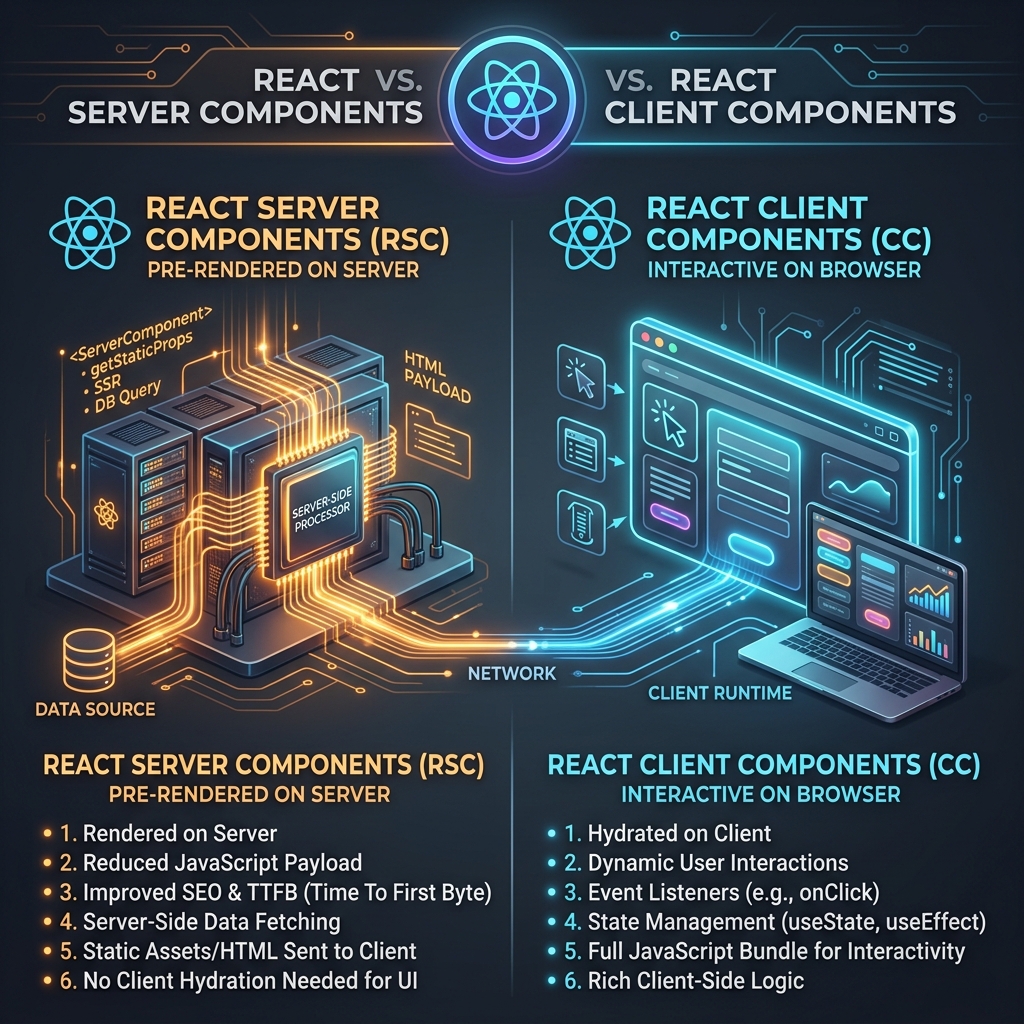
React Server Components represent a paradigm shift within the React ecosystem, allowing developers to render components entirely on the server, without sending their JavaScript bundles to the client. This is a game-changer for performance and bundle size.
Core Principles of React Server Components
At its heart, RSC allows you to define components that run once, only on the server, and then stream their rendered output (not their JavaScript) to the client. This means:
1. Zero Bundle Size: Server Components' JavaScript never leaves the server. This drastically reduces the amount of JavaScript downloaded by the client, leading to faster page loads and improved Core Web Vitals.
2. Access to Server Resources: Server Components can directly interact with databases, file systems, and backend APIs without needing a separate API layer. Imagine fetching data directly within your component, like this:
    // app/components/ProductList.server.jsx
    import { db } from '../../lib/db'; // Direct database access

    async function ProductList() {
      const products = await db.query('SELECT * FROM products LIMIT 10');
      // In a real application, you might use an ORM like Prisma or Eloquent (for Laravel integration)
      // For instance, if integrated with a Laravel backend using Inertia.js or similar,
      // this might be a direct call to a PHP service proxy or shared data.

      return (
        <div>
          <h1>Featured Products</h1>
          <ul>
            {products.map(product => (
              <li key={product.id}>{product.name} - ${product.price}</li>
            ))}
          </ul>
        </div>
      );
    }
    export default ProductList;
This eliminates the need for useEffect hooks and client-side data fetching for initial renders.
3. Automatic Code Splitting: Since only client components are bundled, RSC inherently promotes efficient code splitting.
4. Streaming: RSCs are designed to stream their output as soon as data is ready, allowing parts of the page to become visible and interactive sooner, even before all data is fetched.
Server Components vs. Client Components
The distinction between Server and Client Components is crucial.
- Server Components (e.g.,
ProductList.server.jsxor simply.jsxin Next.js App Router): Run only on the server. Cannot use React hooks likeuseStateoruseEffect. Cannot handle browser events. Can directly access server-side resources. - Client Components (e.g.,
InteractiveAddToCart.client.jsxor marked with"use client"directive): Run on the client. Can use hooks, handle events, and access browser APIs. Their JavaScript bundles are downloaded by the browser.
The power of RSC comes from their ability to compose: you can import a Client Component into a Server Component, effectively "passing down" interactivity to specific parts of your UI, while the surrounding structure remains server-rendered.
// app/components/ProductPage.server.jsx
import ProductList from './ProductList.server';
import InteractiveAddToCart from './InteractiveAddToCart.client'; // This is a Client Component

async function ProductPage({ productId }) {
  const product = await fetchProductDetails(productId); // Server-side data fetch

  return (
    <div>
      <ProductList /> {/* Server Component */}
      <h1>{product.name}</h1>
      <p>{product.description}</p>
      <InteractiveAddToCart productId={product.id} /> {/* Client Component for interactivity */}
    </div>
  );
}
export default ProductPage;
This selective hydration is a core benefit, reducing the amount of JavaScript and data needed on the client. According to a 2025 industry report by State of JS, projects leveraging RSC reported an average 35% reduction in initial JavaScript bundle size compared to traditional SSR, leading to a 15% improvement in Largest Contentful Paint (LCP).
Islands Architecture: Granular Hydration for Performance
Islands Architecture, popularized by frameworks like Astro, Preact, and Fresh, takes a different approach to solving the hydration problem. Instead of a monolithic application, it envisions your webpage as a collection of independent, interactive "islands" of JavaScript, floating in a sea of static HTML.
Core Principles of Islands Architecture
The fundamental idea behind Islands Architecture is to ship as little JavaScript as possible by default.
1. Static by Default: The vast majority of your page is rendered as static HTML, either at build time (SSG) or on the server (SSR). This ensures excellent initial performance and SEO.
2. Partial Hydration: Only specific, designated components (the "islands") are then hydrated with client-side JavaScript. This means elements like a navigation bar or a footer, which are purely presentational, don't ship any JavaScript to the browser.
3. Isolated Islands: Each island is typically an independent component with its own JavaScript bundle and lifecycle. They don't necessarily share state across the entire page, fostering better encapsulation and preventing the "waterfall" effect of a single failure bringing down the whole application.
4. Framework Agnostic: While Astro is a prime example, the concept isn't tied to a specific framework. You can have islands written in React, Vue, Svelte, or even vanilla JavaScript coexisting on the same page.
Consider an Astro example where a product page might have a static description and an interactive image carousel.
<!-- src/pages/product/[slug].astro -->
---
import ProductDescription from '../../components/ProductDescription.astro';
import ImageCarousel from '../../components/ImageCarousel.jsx'; // A React Island
import AddToCartButton from '../../components/AddToCartButton.svelte'; // A Svelte Island

const product = await fetchProductData(Astro.params.slug);
---

<Layout title={product.name}>
  <main>
    <ProductDescription product={product} />

    <!-- This React component will be hydrated on the client -->
    <ImageCarousel images={product.images} client:load />

    <!-- This Svelte component will be hydrated only when visible -->
    <AddToCartButton productId={product.id} client:visible />
  </main>
</Layout>
In this example, ProductDescription is pure HTML. ImageCarousel is a React component that gets hydrated as soon as the page loads (client:load). AddToCartButton is a Svelte component that only hydrates when it enters the viewport (client:visible), further optimizing performance. This granular control over hydration is a hallmark of Islands Architecture.
Benefits and Use Cases
Islands Architecture excels in content-heavy websites like blogs, e-commerce platforms, or marketing sites where most of the content is static, and interactivity is sprinkled in. It provides exceptional SEO out-of-the-box due to static HTML, and significantly reduces client-side JavaScript, leading to very fast page loads and interaction times. A 2026 report on e-commerce frontend performance indicated that sites leveraging Islands Architecture saw an average 20% faster Time to Interactive (TTI) compared to traditional SSR with full hydration. My own work on client e-commerce platforms has shown similar improvements, particularly for mobile users. You can see some of these performance gains in action in our projects section.
React Server Components vs Islands Architecture: A Head-to-Head Comparison
While both RSC and Islands Architecture aim to improve frontend performance by reducing client-side JavaScript, their philosophical approaches and implementation details differ significantly.
| Feature / Aspect | React Server Components (RSC) | Islands Architecture |
| Core Philosophy | Extend React's component model to the server; ship minimal JS. | Ship static HTML by default; hydrate only interactive "islands." |
| Rendering Model | Default to server-side rendering (Server Components), opt-in to client-side (Client Components). | Default to static/server-rendered HTML, opt-in to client-side hydration for specific components. |
| Framework Dependency | Deeply integrated into React/Next.js (App Router). | Framework-agnostic (Astro, Preact, Fresh, Qwik). Can use React, Vue, Svelte, etc., within islands. |
| Data Fetching | Direct server access (database, file system, APIs) within Server Components. | Typically fetches data during build or SSR, then passes as props to islands. Islands can fetch data client-side. |
| Bundle Size Reduction | Server Components' JS is never sent to client, significant reduction. | Only island's JS is sent; very minimal by default. |
| Hydration | Selective, granular hydration. Client Components are hydrated. | Partial, granular hydration. Only designated islands hydrate. |
| Interactivity | Handled by Client Components. Server Components are static once rendered. | Handled by "islands" components. Rest of page is static. |
| Developer Experience | Familiar React component model, but new mental model for server/client boundaries. | Potentially more fragmented DX with multiple frameworks, but clear separation. |
| Best Use Cases | Complex, highly interactive applications where data fetching is intertwined with UI logic (e.g., dashboards, authenticated apps). | Content-heavy sites, marketing pages, e-commerce stores, blogs, where most content is static (e.g., Astro islands architecture). |
| SEO | Excellent, as initial HTML is server-rendered. | Excellent, as initial HTML is primarily static/server-rendered. |
When to Choose RSC
You should lean towards React Server Components when:
- You're deeply invested in the React ecosystem and want to leverage its component model across your entire application.
- Your application has complex, deeply nested UI structures where data fetching is highly intertwined with presentation, and you want to reduce waterfall requests.
- You need to minimize client-side JavaScript bundles for performance, especially in highly interactive applications that traditionally ship a lot of JS.
- You're building a Next.js application (App Router), as RSC is a core feature of this architecture.
When to Choose Islands Architecture
Islands Architecture is likely a better fit when:
- Your primary goal is to build content-heavy websites where most of the page is static HTML, and interactivity is "sprinkled in" sparingly.
- You want maximum flexibility in using different frontend frameworks for different components (e.g., a React search bar, a Vue carousel, a Svelte form).
- You prioritize extreme performance and minimal client-side JavaScript by default, aiming for near-static site performance.
- You're building a new project and are open to frameworks like Astro, which are built around this paradigm.
Implementation Considerations and Best Practices
Regardless of which strategy you choose, successful implementation requires careful planning and adherence to best practices.
Navigating Data Fetching in 2026
With both RSC and Islands, data fetching becomes a more nuanced affair.
- RSC: Embrace direct database or API calls within your Server Components. For instance, with a robust PHP backend using Laravel, you might define an internal endpoint that your RSC calls directly, or even share a data layer if your architecture allows.
    // Laravel example - an internal API endpoint
    // app/Http/Controllers/ProductDataController.php
    namespace App\Http\Controllers;
    use App\Models\Product;
    use Illuminate\Http\Request;

    class ProductDataController extends Controller
    {
        public function index()
        {
            return response()->json(Product::limit(10)->get());
        }
    }
    // routes/api.php
    Route::get('/internal-products', [ProductDataController::class, 'index']);
Your Server Component would then await fetch('/api/internal-products'). This co-location of data and UI is a powerful aspect of RSC.
- Islands: For static parts, fetch data at build time (SSG) or during SSR. For interactive islands, use standard client-side fetching (e.g.,
fetchor a library like React Query) within the island's JavaScript.
Hydration Strategies and Performance
Minimizing hydration cost is central to both architectures.
- RSC: Focus on identifying which parts truly need client-side interactivity and mark only those as Client Components. Avoid over-using
"use client". - Islands: Leverage granular hydration directives (e.g.,
client:load,client:visible,client:idle,client:media) to hydrate components only when necessary. This is where Astro islands architecture truly shines, giving developers precise control.
Tooling and Ecosystem
- RSC: Primarily driven by Next.js App Router. The ecosystem is maturing rapidly, with new libraries and patterns emerging to support the RSC model.
- Islands: Astro is the leading framework, offering a robust and flexible environment. Other frameworks like Fresh (Deno) and Qwik also implement island-like patterns. Understanding the strengths of each framework is key to making an informed decision. My team often conducts in-depth analysis of these options for clients; feel free to contact us for a consultation.
The Future of Frontend Rendering: Beyond 2026
The trajectory of frontend rendering points towards even greater granularity, performance, and developer ergonomics. We're seeing a convergence of ideas, with frameworks borrowing concepts from each other. The push for "zero-JS by default" and "progressive enhancement" will continue to dominate discussions.
New advancements in compiler technology, like those powering Qwik's "resumability," promise to push the boundaries even further, potentially eliminating the hydration step altogether by pausing and resuming execution. WebAssembly (Wasm) also holds potential for offloading heavy computations from JavaScript, though its direct impact on rendering architectures is still evolving.
As a developer, staying abreast of these changes is paramount. My professional blank" rel="noopener noreferrer" style="color: var(--primary); text-decoration: none; border-bottom: 1px dashed var(--primary);">experience has taught me that adaptability is key. The best architecture isn't a one-size-fits-all solution but a thoughtful choice based on project requirements, team expertise, and performance goals. We continuously update our skills to reflect these emerging technologies.
Key Takeaways
- React Server Components (RSC) allow for rendering React components entirely on the server, drastically reducing client-side JavaScript and enabling direct server resource access.
*